Are you stuck with technical documents from the NBR sheet manufacturers that feel like big jigsaw puzzles? Is the NBR rubber data sheet full of difficult words, testing standards, and numbers?
A NBR rubber sheet is commonly known as the Nitrile rubber sheet. An NBR or Nitrile rubber sheet is popular for its extreme oil resistance and durability in harsh working conditions.
Have you ever bought a product reading “NBR” but found out it doesn’t meet your temperature or abrasion requirements?
Many buyers who plan to buy an NBR sheet, supposedly a 3 mm Nitrile rubber sheet, fail to look at the Technical Data Sheets during purchase. Or, they find it too tough to understand. Are you one of them seeking help decoding the NBR rubber data sheet?
Go through this detailed, short, and expert-written blog before your next purchase!
What is an NBR rubber data sheet?
The NBR sheet manufacturers note down the physical features, chemical resilience and mechanical properties of the product they made. This helps them comply with various testing standards and fix a customized rubber sheet NBR price for their product.
The document containing all the necessary details is called a Technical Data Sheet or TDS.
Click here to get a sample TDS of a Duratuf NBR Sheet.
What information does the technical data sheet contain?
Imagine you are looking for a colored Nitrile rubber sheet, and the manufacturer hands you a piece of paper with details of the product. Won’t you be curious about the content?
Well, the paper the manufacturer or supplier hands you for your 3 mm Nitrile rubber sheet is its TDS. The TDS can also be in digital form.
The Technical Data Sheet or the NBR rubber data sheet will contain the following parts:
Product overview:
This part tells you more about the product. The composition, suggested usage and unique features of the Nitrile sheet.
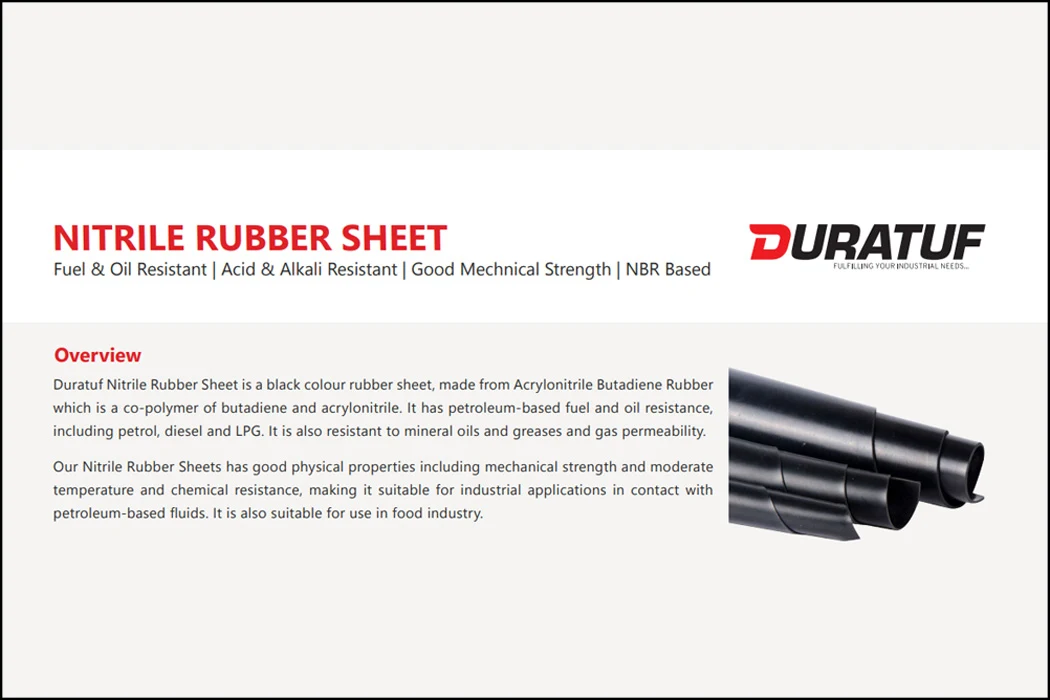
Above is the sample TDS of a Duratuf Nitrile rubber sheet variant. You can see here, the document starts with the product name, followed by some of its features and some descriptions.
Technical information:
The technical information part contains the physical, mechanical, and chemical properties of the product. We are describing this in detail later in this blog.
| Product Code | Polymer | Sp. Gravity | Hardness (Shore A) | Tensile Strength (Min.) | Elongation (Min.) | Colour | Surface Finish |
|---|---|---|---|---|---|---|---|
| RS-10NBR-14065G-BLAPP | 10% NBR | 1.40 ± 0.05 | 65° ± 5° | 4 MPa | 250% | Black | Top & Bottom – Plain |
| RS-30NBR-13565G-BLAPP | 30% NBR | 1.35 ± 0.05 | 65° ± 5° | 5 MPa | 300% | Black | Top & Bottom – Plain |
| RS-50NBR-14065S-BLAPP | 50% NBR | 1.40 ± 0.05 | 65° ± 5° | 5 MPa | 300% | Black | Top & Bottom – Plain |
| RS-100NBR-15070S-BLAPP | 100% NBR | 1.50 ± 0.05 | 70° ± 5° | 5 MPa | 200% | Black | Top & Bottom – Plain |
| RS-100NBR-12565P-BLAPP | 100% NBR | 1.25 ± 0.05 | 65° ± 5° | 12.5 MPa | 400% | Black | Top & Bottom – Plain |
| RS-NBR-CUS | 10–100% NBR | 1.20 – 1.50 ± 0.05 | 40°–75° ± 5° | 4–17 MPa | 200–500% | Any | Any |
G – General Grade | S – Standard Grade | P – Premium Grade | CUS – Custom Design
Dimensions:
After the technical information comes the part depicting the NBR sheet’s standard thickness, roll size, temperature range and manufacturer’s note.
| Standard Thickness | 2mm,3mm,4mm,5mm,6mm,10mm,12mm,15mm,20mm,25mm |
|---|---|
| Standard Roll Size | 1200mm x 10Mtrs for upto 10mm & 1200mm x 5M for upto 25mm thick |
| Temperature Range | -30°C to +120°C |
Cut lengths, strips, custom shapes, surface finish and colours are available upon request
Note: Manufacturing tolerance of ± 10% on thickness, ± 5% on length & ± 2% on width shall be applicable
Product applications:
It is important for the 3 mm Nitrile rubber sheet buyers to know about the product applications before they pay a hefty rubber sheet NBR price. The TDS contains that too!
Ordering Info:
This is the last part of the NBR rubber data sheet. This part highlights the details buyers need to provide to make an application-fit purchase.
Breaking Down the Technical Information Table of the NBR Rubber Data Sheet
The technical information table is the most important part of the data sheet, yet most buyers overlook the numbers. Misunderstanding key parameters leads to costly downtime, safety issues, or warranty disputes.
Below is a step-by-step guide to reading the technical information part of an NBR rubber data sheet.
Column 1: Product or SKU code
The product or SKU (Stock Keeping Unit) code is used to mark the product. In the NBR data sheet, which we are using in this blog, this column on the right-most side is the product code:
Let’s break it down for the first one, RS-10NBR-14065G-BLAPP:
- RS means Rubber Sheet
- ’10’ depicts the polymer content. 10 means 10% polymer
- 140 denotes specific gravity, 65 is the hardness, and G stands for grade, which here is- General
- BLA is the ‘Black’ color
- PP is surface design. Here, it is plain on both sides
Column 2: NBR Content / Grade
Duratuf offers multiple NBR grades, from 30% NBR blends to 100% pure NBR
- What it means: Polymer percentage shows how much of the base polymer is Nitrile Butadiene Rubber versus fillers or other elastomers.
- Why is it important: Higher NBR content in the NBR sheet increases oil, fuel, and hydrocarbon resistance but can make the sheet less flexible. The rubber sheet NBR price is more for a 100% pure product.
Column 3: Specific Gravity
It can range from 1.20 to 1.50, depending on grade.
- What it means: Density of the rubber in g/cm³.
- Why is it important:
- A lower specific gravity often means more air or lighter fillers — affecting strength and wear.
- Higher value indicates more fillers or a denser, stronger formulation.
It is one of the 8 tests that determine the durability of the Nitrile rubber sheet.
Column 4: Hardness (Shore A)
The hardness of Duratuf NBR sheets generally read 65 ± 5 Shore A.
- What it means: A standardized scale (Shore A) measures surface hardness — 0 is soft like gel, 100 is very hard.
- Why is it important:
- Higher hardness (65-70) → More rigid, better wear resistance, less flexible.
- Lower hardness (40) → Softer, better sealing, but wears faster.
Column 5: Tensile Strength
The tensile strength in NBR rubber data sheet ranges from 4 MPa (blends) to 12.5 MPa (pure NBR) in Duratuf specs.
- What it means: The maximum pulling force the sheet can handle before breaking.
- Why is it important:
- Higher tensile strength = more durable under stretching or load.
Column 6: Elongation at Break
Duratuf’s NBR sheets offer EB from 200% to 400%+.
- What it means: The percentage a sheet can stretch before breaking.
- Why is it important:
- High elongation is critical for flexible seals or parts subject to movement.
- Lower elongation may be fine for static, rigid applications.
Column 7 & 8: Color and Surface Finish
Last column in this NBR rubber data sheet is its color and finish.
Conclusion
An NBR rubber sheet TDS may be more advanced, with more columns and detailed features. Nevertheless, what we decoded above will suffice for someone who has just entered the rubber sheet industry.
Whether you want to buy a 3mm Nitrile rubber sheet or a colored Nitrile rubber sheet, what you need most is an expert opinion. This is why we are for all our buyers.