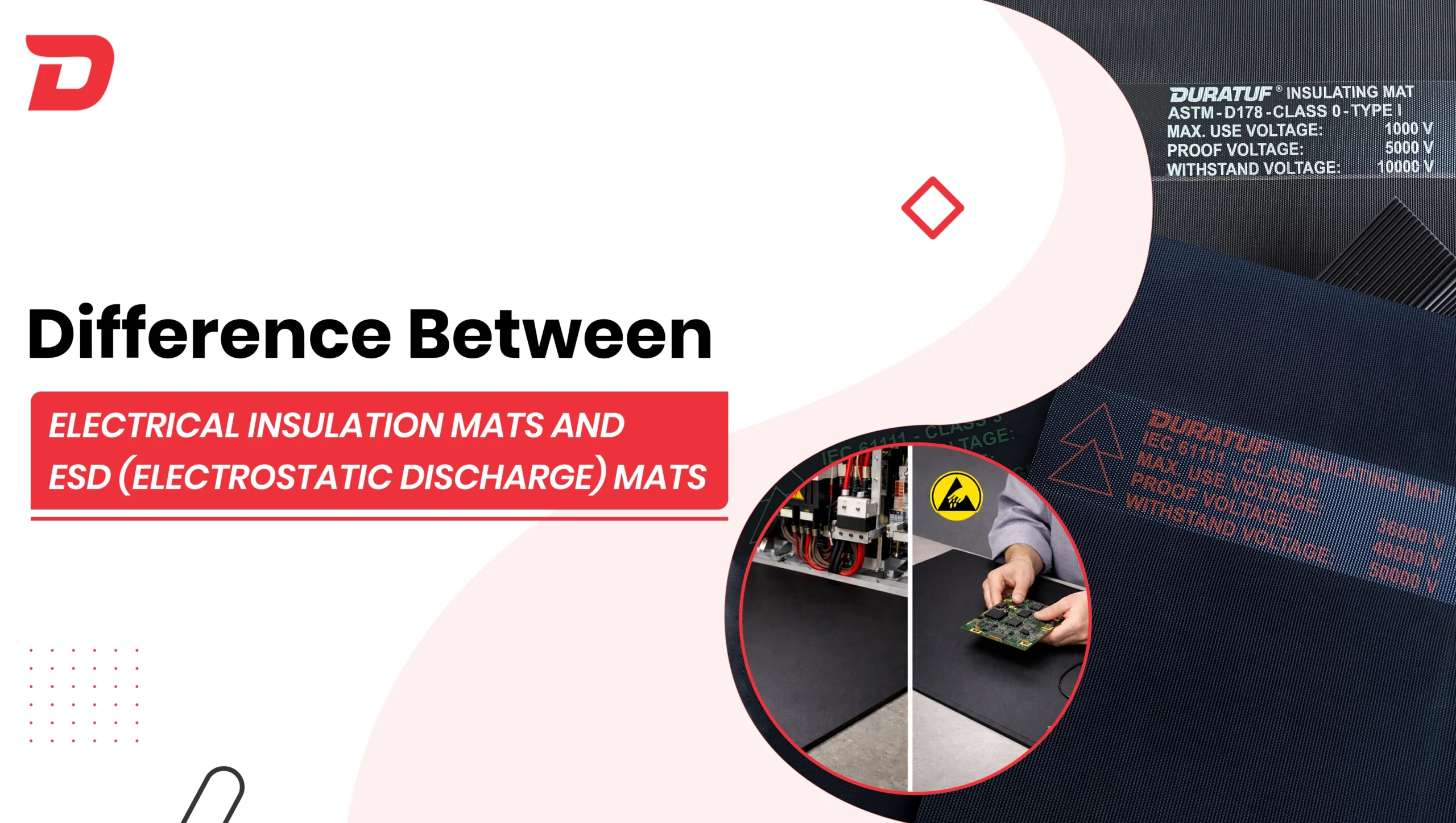
In this domain blog, we will help you understand the difference between electrical insulation mats and electrostatic discharge mats. From features to their placements, we will explore how they stand apart, considering various metrics.
Your purchase team has purchased a mat for electrical safety.
But even with the mat on…workers have been getting mild burns from electrical accidents.
After checking, you find out they are ESD mats, not electrical insulating mats. Read on this blog to avoid such confusion.
Electrical insulating mats vs ESD mats: Key Comparison
Misleading product terminologies, lack of technical knowledge and awareness before purchase, visual similarity, or inadequate guidance can confuse you between electrical insulating mats and ESD mats.
Such confusion can often lead to wrong purchases.
Definition
Electrical insulating mats are protective equipment. They ensure the electrical safety of the workers operating high-voltage applications. These mats comply with industrial safety standards and regulations.
ESD mats are also protective gear. However, they control static electricity and dissipate it to protect sensitive equipment. ESD mats can come in various colors. They come as a kit with grounding cords and wrist straps.
Features
Insulating mats come in different classes (for IEC 61111:2009 and ASTM D178 mats (Type I and II): Class 0 to 4, and for IS 15652:2006: Class A, B, C). Each class has different working voltages, AC-proof voltages, dielectric strengths, and thicknesses. Besides, they can also come with an anti-skid design, such as a ribbed or dotted surface texture. ASTM D178 Type II (ABC) mats are ozone, flame, and oil-resistant.
ESD mats can have two or three layers. Their bottom layer is conductive, and their top layer is static-dissipative. They have a ground point for dissipation. Besides, the ESD mats can also have a middle layer that is conductive. They are available as table and floor mats.
Purpose and Uses
The primary purpose of insulating mats is to protect workers from electrical accidents such as electric shocks, arc flashes, current leakage, and more. They are used in the power industry, manufacturing units, the automotive and aerospace industries, and other industries where high-voltage applications are common. Owing to their anti-skid properties, they also reduce the risk of slips and falls.
The main purpose of ESD mats is to protect sensitive devices such as electronic components, microchips, instruments, and circuit boards. They have common applications in PCB assembly lines, laboratories, electronics manufacturing units, and others.
Electrical Behavior
Electrical safety mats are non-conductive in nature. During an electric shock, the current tends to pass through the operator’s body because it is a low-resistance path. Thus, an electrical mat prevents current from passing through unintended paths.
ESD mats conduct static electricity to the ground. As a result, it cannot protect you from electrical accidents while you are operating high-voltage systems.
Installation
Installation of insulating mats is quite simple. You need to have mats with proper dimensions as per your application area. The application area should be free from dust, dirt, and grease. For thinner mats, you can use adhesives (thicker mats do not require adhesives). Properly place the insulating mat, and you can use a roller to secure its placement.
ESD mats should have a connected grounding point. Ensure there is continuity between the mat and the ground. However, without proper grounding, you should not install the ESD mats in highly insulating places.
Placements
You can install electrical rubber mats near HT/LT panels, switchboards, transformer rooms, control panels, generators, lift rooms, and other high-voltage areas.
Install ESD mats on repair areas, workstations, and where protection of sensitive components is required.
Conclusion
Electrical insulation mats protect people from life-threatening electric shocks by acting as a non-conductive barrier between the high voltage source and the ground. ESD mats protect electronic components by safely conducting or dissipating static electricity away from sensitive devices.
Make sure to know their differences before making a purchase decision!
Frequently Asked Questions
What are the different standards of electrical safety mats?
Electrical safety mats primarily come in IEC 61111:2009 (set by the International Electrotechnical Commission), ASTM D178 (set by the American Society for Testing and Materials), and IS 15652:2006 (set by the Bureau of Indian Standards). There are other standards, such as BS EN 61111, AS/NZS 2978:1995, SIRIM, and others.
How to make sure you are purchasing the right insulating mat?
You should make sure that their working voltages and other electrical insulation specifications are suitable for your application. Besides, you should also make sure that they come with certifications and markings that prove their reliability.
How to choose a reliable supplier?
A reliable supplier has a positive reputation in the market. In addition, they have great reviews across social media platforms, Google, and e-commerce platforms. Customer testimonials, case studies, and appropriate certifications prove the reliability of the supplier.