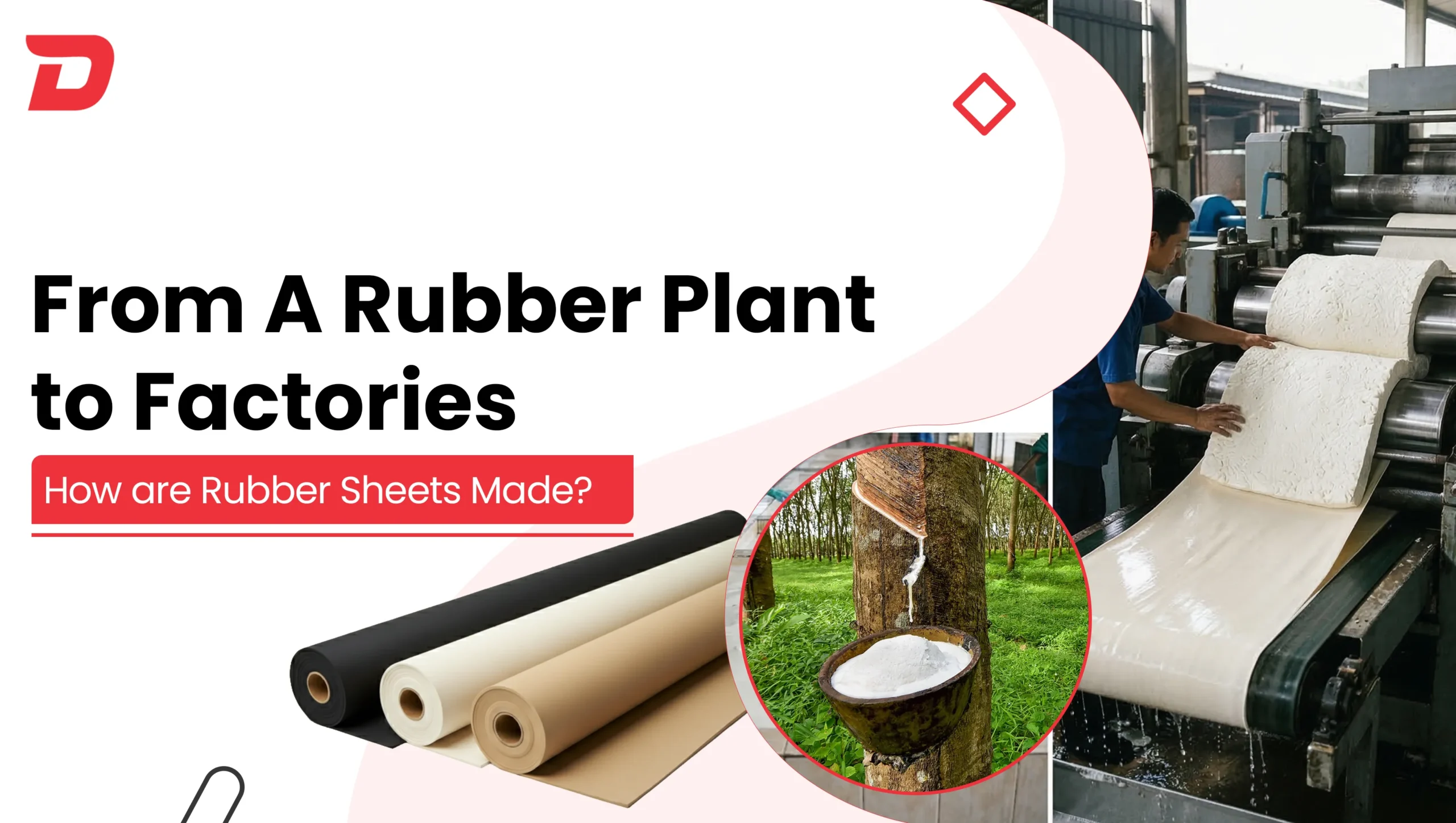
Have you ever stopped to think about the journey of the rubber sheet beneath your feet?
How is the liquid latex from a rubber plant remolded into solid rubber sheets?
How can this seemingly simple product of a ficus rubber mat have insulating properties?
Rubber boasts a fascinating story, stretching from the lush greenery of rubber plantations to the intricate machinery of factories. Today, we embark on this journey, exploring the process of making rubber sheets, focusing on natural rubber derived from rubber trees (specifically, ficus rubber plants).
Rubber Sheet Manufacturing Process: Step by Step
From Tapping To Collection: Harvesting The Liquid Silver From Rubber Trees
How is latex turned into rubber? Our story begins in vast rubber plantations, where rows upon rows of rubber trees stand tall. These trees, upon reaching maturity, are ready for a process called tapping. Skilled workers make carefully angled cuts on the bark, disrupting the latex vessels and causing a milky white liquid, known as latex, to ooze out. Latex contains approximately 40% rubber and 55% water.
Believe it or not, the elongation and tensile properties of the rubber comes from the latex of a ficus rubber plant.
Now, this liquid silver, the very essence of natural rubber, is collected in cups attached to the rubber trees.
Question: Which Country Is First In Rubber Plantation?
Answer: Thailand
Coagulation: Transforming The Latex From Rubber Plant
The collected latex, though crucial, is still in its raw form as obtained from the ficus rubber plant. To transform it into a usable solid, a process called coagulation comes into play in the making of rubber.
In this step, the rubber plant latex is treated with specific acids or chemical compounds, causing the rubber particles to clump together and separate from the watery serum. This separation results in a white, rubbery mass.
Rolling And Drying: Making Of Rubber
The coagulated rubber, still quite wet, needs to be further processed. It is passed through a series of rollers, which help squeeze out excess water and shape the rubber into thin sheets. These sheets are then dried, traditionally done by one of three methods:
Air drying: The sheets are simply hung in well-ventilated areas, allowing the natural air to remove moisture.
Smoke drying: This method involves exposing the sheets to controlled smoke from burning wood or palm shells. The smoke dries the rubber and imparts its characteristic brown color. This stage also acts as a natural preservative in the making of rubber.
Mechanical de-watering: Nowadays, the technology applied in the making of rubber has advanced. Therefore, the traditional ‘pressing’ or ‘centrifugation’ is now done with the help of heavy machinery.
Natural Rubber Vulcanization: The Finishing Touch
Yes, due to the inherent properties of latex, obtained from a rubber plant, the dried rubber sheets are elastic in nature. Nonetheless, they still lack strength and durability, mandatory for various applications.
Here is where the vulcanization of natural rubber, a process introduced in the 19th century, comes into the picture.
During natural rubber vulcanization, the rubber sheets are passed through high heat and pressure. Sulfur is often added in this step to create the effect. As a result of this process, cross-links are formed in between the rubber molecules, increasing the strength, elasticity, resistance to wear and tear of the material.
From Plantation To Rubber Sheets: The Final Steps
After natural rubber vulcanization, the rubber sheets undergo a series of final processes, including:
- Washing to remove any residual chemicals used in the making of rubber.
- Curing to further optimizing the rubber’s properties for specific applications.
- Testing to ensure the sheets meet the required quality standards.
- Cutting and finishing to customize the sheets to specific sizes and shapes based on their designated use.
Finally, the finished rubber sheets are ready to embark on their next journey, finding their way into various applications ranging from tires and hoses to flooring sheets and insulating mats.
Duratuf Rubber Sheets: Fit For Every Industry
Duratuf practices and promotes ethical sourcing of rubber from rubber trees . We choose govt approved manufacturing processes in the making of rubber sheets. At Duratuf, we consider following sustainable practices while manufacturing our rubber sheeting.
In 2024, we have also advanced to the latest technology that offers our buyers maximum comfort in the rigorous buying journey.
Why Duratuf:
- Premium Quality Products
- Ready Stock
- 1 Year Product Warranty
- Fast Delivery
- 7 Warehouses Worldwide
- Localized Supply
What if we say we can ease your pain of industrial rubber sheet purchase?
Yes, at Duratuf, you get 16 types of rubber sheets, all under 1 roof, being one of the experts in the making of rubber sheets. Our rubber sheeting has extensive applications in the oil & gas sectors, manufacturing units, automotive sectors, and other industries.
For example, choose the General Purpose rubber sheet for affordable flooring. Or, get the Nitrile rubber sheet for applications involving chemicals.
Need quotes? We respond within 60 minutes.