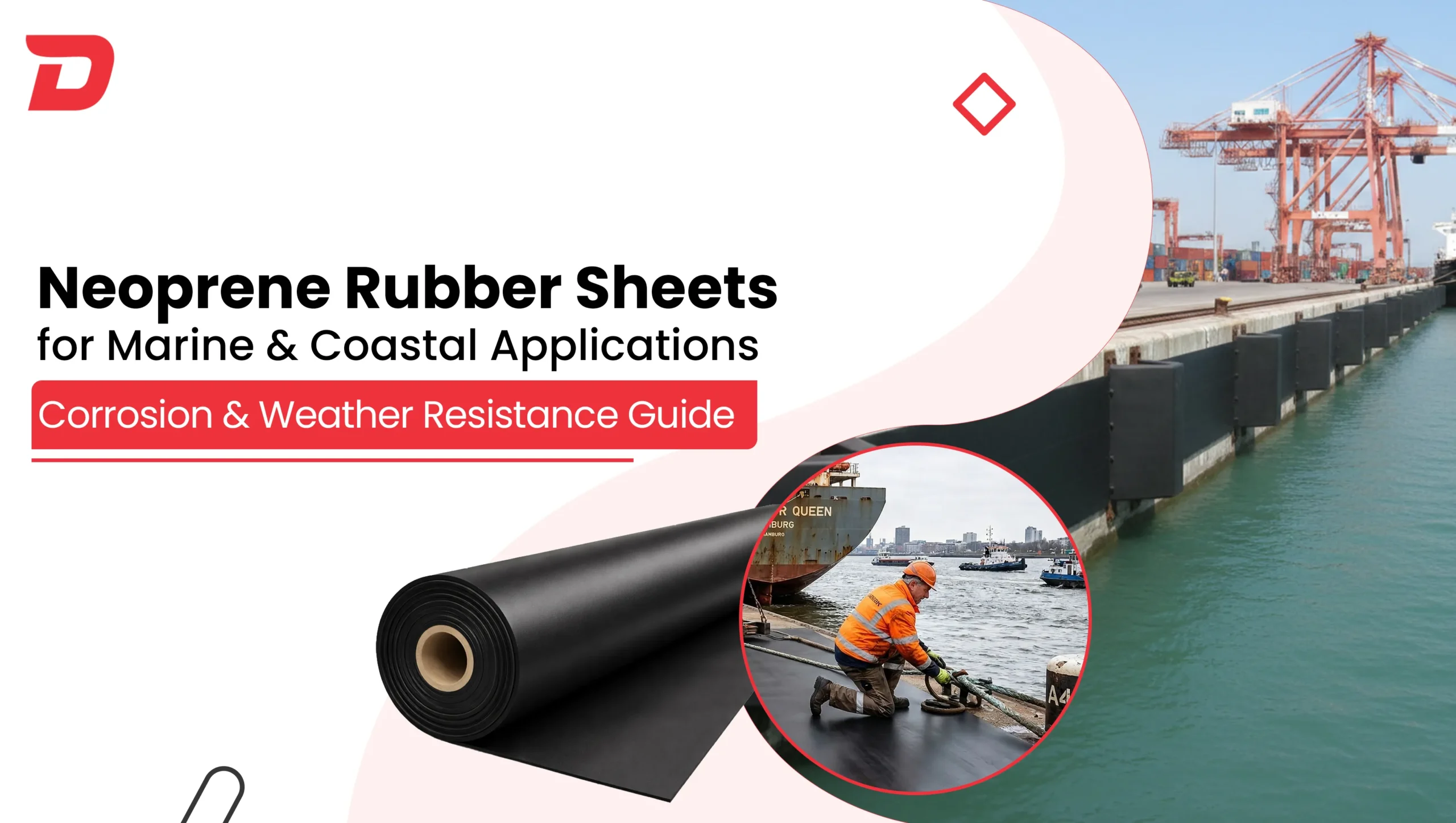
Maximum materials tend to degrade and damage in marine applications. Hence, buyers often think what material to use for applications where constant saltwater exposure and corrosion are common? The expert answer is- neoprene rubber sheets for marine applications.
From dock bumpers to marine decks, neoprene rubber sheets provide the best performance. Want to know more? Read this blog.
Why Neoprene Rubber Is Suitable for Marine and Coastal Environments
Along with their superior saltwater resistance, there are other factors that make Neoprene rubber sheets ideal for marine and coastal environments.
They are as follows:
Saltwater and Corrosion Resistance
Any form of marine component corrodes with exposure to saltwater. Neoprene rubber sheets for marine applications provide a protective layer to prevent such corrosion.
UV and Weather Resistance
Neoprene rubber sheets for marine applications are always used outdoors. They have a high level of sunlight, ozone, and UV resistance. Their weather resistance properties allow them to remain stable even in such outdoor conditions.
Temperature Stability
Coastal applications demand materials with good temperature resistance. Neoprene rubber sheets can endure temperatures ranging from -30 degrees to +100 degrees centigrade.
Mechanical Strength and Durability
Neoprene rubber sheets for marine applications have tensile strength of 4 MPa to 10 MPa and elongation at break of 200% to 350%. In addition, they have a hardness value of 65 ± 5° Shore A. As a result, they can endure huge physical stress without getting damaged.
Common Marine & Coastal Applications of Neoprene Rubber Sheets
Check out 3 top applications of Neoprene rubber sheets in the marine sector:
Shipbuilding and Marine Equipment
Neoprene rubber sheets for marine applications are used for vibration isolation, pipeline and pump gaskets, seals, as well as protective linings for marine equipment. In this way, shipbuilding and marine equipment do not require frequent repairs or replacements.
Ports, Harbors, and Dock Infrastructure
Ports, harbors, and dock infrastructure have significant structural impact, saltwater exposure, and mechanical stress. Neoprene rubber sheets for marine applications are used to make dock bumpers, expansion joint seals, and fender systems.
Coastal Industrial Installations
Offshore support bases, marine processing units, and other coastal facilities are mainly exposed to salt-laden air, humidity, and weather changes. As a result, neoprene rubber sheets for marine applications are used for seals, protective covers, and protective liners in these installations.
Key Factors to Consider When Selecting Neoprene Rubber Sheets for Marine Use
You should make sure that you convey the marine conditions to get the best-suited Neoprene rubber sheets for your application. To ensure that, there are some factors that you should consider:
Saltwater Exposure Level
Saltwater has corrosive effects on any material. Hence, you should make sure that the neoprene rubber sheets have good resistance against saltwater and do not degrade with exposure to it.
UV Exposure
As marine applications have constant UV exposure, you should choose neoprene rubber sheets for marine applications with high UV resistance. Thus, they should not fade in color or develop cracks in UV exposure.
Thickness and Sheet Size
The neoprene rubber sheets for marine applications should have the adequate thickness required for the application. Besides, their length and width should be appropriate for the application, providing a precise fit.
Mechanical Stress Conditions
They should be able to endure mechanical forces of waves, vibrations, or vessel movement. Thus, they should remain flexible and intact even in high stress levels.
Common Challenges in Marine Environments and How Neoprene Helps
Marine environments bring many challenges for ship building and marine equipment. However, Neoprene rubber acts as a savior in marine environments.
- Corrosion damage: Equipment and structures used in marine applications can corrode. Neoprene rubber sheets for marine applications act as protective liners, pads, or layers to shield them from corrosion due to seawater exposure.
- Weathering: Constant exposure to outdoor conditions can degrade material quality. Neoprene sheets remain stable in such conditions.
- Material cracking: Temperature fluctuations can crack materials. Neoprene rubber sheets for marine applications can withstand temperatures between -30°C to +110°C.
- Water penetration: Intricate parts of marine equipment can get damaged with water ingress. Sealing with the help of neoprene rubber sheets prevents such water leakage.
Best Practices for Using Neoprene Rubber Sheets in Coastal Installations
Follow these guidelines for effective performance and extended life span of Neoprene rubber sheets in coastal installations:
- Use marine-grade neoprene: You should use neoprene rubber sheets suitable for marine applications for an extended lifespan. Ask your supplier for compatibility.
- Ensure proper thickness selection: A wrong thickness will not allow your rubber sheets to perform effectively.
- Inspect materials periodically: Make sure your neoprene rubber sheets for marine applications are in good condition, without any signs of damage or degradation.
- Use appropriate adhesives or fasteners: Ensure that the adhesives are compatible with marine conditions.
Choosing a Reliable Supplier for Marine-Grade Neoprene Rubber Sheets
Procurement teams should look for these qualities in a supplier for purchasing:
- Material quality: The suppliers should provide quality-assured, certified neoprene rubber sheets for marine applications.
- Compliance: Their products should be compliant with the industrial standards and regulations, such as REACH and RoHS.
- Consistency in bulk supply: Each batch of neoprene rubber sheets for marine applications should be tested for consistent quality.
- Technical support: Your supplier should provide ready technical support both before and after sales.
Conclusion
Neoprene rubber sheets have extensive applications in the marine sector. Their weather resistance, corrosion resistance, and mechanical strength help them deliver high-end performance. You should make sure to choose a reputable and reliable supplier for quality-assured and durable neoprene sheets. For more details, contact us now!