• inquiry@duratufproducts.com
  • +91-80880-01133
header_logo
  • Home
  • Company
  • Products
        • Insulating Mats
        • XVolt Electrical Insulating Mats – IS 15652:2006
        • Duratuf Electrical Insulating Rubber Mats – IEC 61111:2009
        • Duratuf Switchboard Mats – ASTM D178
        • EProtect Electrical Safety Matting
        • Rubber Sheets
        • Natural Rubber Sheet
          • DuraGen70 Lite
          • DuraGen55 X
          • DuraGen70 X
          • DuraGen75 X
          • DuraBlast45 Pro
          • DuraBlast55 Pro
          • DuraBlast65 Pro
          • DuraBlast45 Max
          • DuraBlast65 Max
        • Abrasion Rubber Sheet
          • Abra40 Pro
          • Abra60 Pro
          • Abra38 Max
          • Abra40 Max
          • Abra60 Max
        • Butyl Rubber Sheet
          • ButylShield60 Pro – Bromo
          • ButylShield60 Pro – Chloro
        • Chlorosulfonated Rubber Sheet
          • Hypa60 Pro
        • Chloroprene Rubber Sheet
          • Neo65 Lite
          • Neo60 X
          • Neo65 Pro
          • Neo65 Max
        • EPDM Rubber Sheet
          • EPShield65 Lite
          • EPShield60 X
          • EPShield60 Pro
          • EPShield60 Max
        • Food Grade Rubber Sheet
          • FoodSafeNR60 Pro
          • FoodSafeNBR60 Pro
          • FoodSafeEPDM60 Pro
        • Fluoroelastomer Rubber Sheet
          • Fluoro75 Pro
        • Nitrile Rubber Sheet
          • Nitri65 Lite
          • Nitri65 X
          • Nitri65 Pro
          • Nitri65 Max
        • Silicone Rubber Sheet
          • Silico60 X
          • Silico60 Pro
        • Conveyor Belts
        • General Purpose Conveyor Belts
        • MaxGuard Conveyor Belts
        • Guardian Conveyor Belts
        • LiteGuard Conveyor Belts
        • FireGuard Conveyor Belts
        • HeatGuard Conveyor Belts
        • OilGuard Conveyor Belts
        • Conveyor Accessories
        • Pulley Lagging Sheets
          • DuraPulley60 X
          • DuraPulley65 Pro
          • DuraPulley60 Max
        • Ceramic Lagging Sheets
          • DuraCeraTile70 Max
        • Impact Bars
          • DuraIBar45 Pro
          • DuraIBar60 Pro
          • DuraLBar60 Pro
          • DuraGBar60 Pro
        • Skirt Board Sheets
          • DuraEdgeGuard45 X
          • DuraEdgeGuard55 X
          • DuraEdgeGuard45 Pro
          • DuraEdgeGuard40 Max
        • Cold Bonding Adhesive
          • DuraLokGen Pro
          • DuraLokHR Pro
        • Repair Patch
          • DuraPatch60 Pro
          • DuraStrip60 Pro
  • Resources
        • Blogs
        • Technical Assets
        • Certificates
        • Industries
        • Locations
        • FAQ
        • Case Studies
        • Warranty
        • Track Shipment
  • Careers
  • Contact Us
  • Duratuf
  • /
  • Blogs
  • /
  • How Oil Resistant Rubber Belting Helps the Farmers During the Winter Harvest Season?
Oil Guard Conveyor Belt

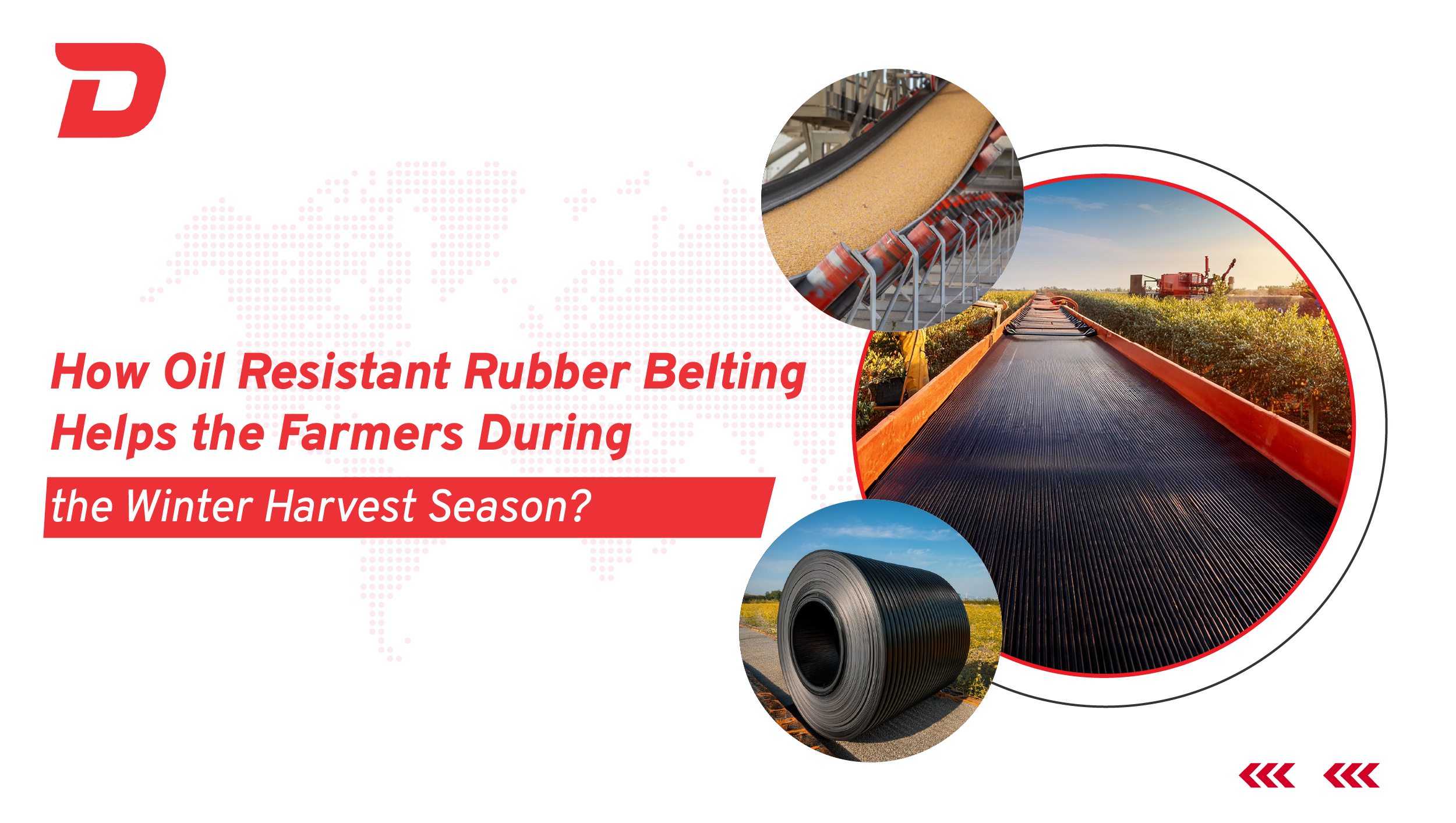
How Oil Resistant Rubber Belting Helps the Farmers During the Winter Harvest Season?

Is your farm ready for the winter harvest? Are you still relying on manual labor? What if we say you can enhance your farm’s operations with rubber belting?

The harvest season is the most critical time for the farmers. Even if your year’s produce is satisfactory, timely harvesting them is necessary to enjoy good profits. Although many farmers still do not prefer to trust modern equipment like a rubber conveyor belt on their farm- change becomes inevitable sometimes.

Rubber belt conveyor works on automated systems. They are used to transport bulk materials from one place to another- no matter the distance.
However, you cannot use just any type of rubber belt conveyor when it comes to transporting food grains, nuts, seed kernels, etc. Do you know why?
Which rubber conveyor belt material is fit for farm use then?

Why Are Some Crops Harvested in Winter?

The winter marks the occurrence of a lot of Indian harvest festivals- Lohri, Makar Sankranti, and Bihu. On the other hand, globally, we have various winter/autumn harvest festivals like the Sukkot and Thanksgiving, as well.
Now, why are crops harvested during this time when the weather is so harsh?

Looking for Rubber Sheet, Insulating Mats & Conveyor Belts ?
We are here to help you.
Call Us Now

Winter Harvest: Rubber Belting Contributes to Resilience in Cold and Greasy Conditions

Wheat, Barley, Mustard, and Rapeseed are mainly harvested among the other winter or Rabi crops. However, the weather is cold and wet outside. If you take too much time harvesting them, it will damage the crops. Nevertheless, belt conveyor rubber makes the process first. The synchronization of rubber belting, conveyor pulleys, motors, and other parts of a conveyor system can transport bulk material in less time than labor.

Post Winter Harvest: Rubber Conveyor Belt Managing Heavy-Duty Operations

As the winter season slowly bids goodbye, it becomes time to harvest heavy crops like sugarcane and rice. The problem with sugarcane harvest is- you cannot wait too long to send them to the sugar mills. Since the crop is mostly used to make refined sugar, wilted, dry, or withered sugarcane will not give you a good price.
This period demands high-capacity equipment capable of handling heavier loads without failing under stress- a rubber belt conveyor.

Early Spring: Rubber Belt Conveyor For Added Efficiency

Crops are not usually harvested during early spring. However, this is the time when farmers prepare for the busy harvest season once again in the late summer. Investing some time now to maintain rubber conveyor belting saves farmers both time and money.

Oil Resistant Rubber Belting to the Rescue: Why Cannot You Use Anything Else?

Belt conveyor rubber comes in different variants. According to rubber belting suppliers, there are:

  • Abrasion-resistant rubber belting
  • FR-grade or fire-resistant rubber belting
  • HR-grade or heat-resistant rubber belting
  • OR-grade or oil-resistant rubber belting

What is Oil-Resistant Rubber Conveyor Belt Material?

Oil-resistant rubber conveyor belting is made of high-quality rubber that can withstand oil, grease, and fat. Typically, rubber degrades when it comes in contact with oil or grease. The rubber can absorb the oil or grease, causing it to expand in size, leading to changes in shape. Additionally, oil or grease can soften the rubber, making it less rigid and more prone to deformation or tearing. Therefore, if you use an abrasion resistant rubber conveyor belt or a fire-grade rubber belt conveyor, it will ultimately be of no use; additionally, it will require and lead to:

  • More Replacements: You cannot use swollen belt conveyor rubber and will need more replacements.
  • Financial Loss: Evidently, you will have to spend more when there are frequent replacements and repairs of the rubber belting.
  • Production Downtime: You cannot work with faulty systems causing production downtime.

Benefits of Using An Oil Resistant Rubber Belting

While other types of belt conveyor rubber might not be suitable for your farm’s operations, an oil-resistant rubber belting brings you these benefits:

  • Resistance to Oils and Grease: Prevents swelling, cracking, or degradation caused by exposure to crop oils, lubricants, and greasy residues.
  • Durability in Extreme Conditions: Some variants, like a 6 ply rubber belt, are tough and perform efficiently in cold winters and high-stress environments, ensuring reliability across seasons.
  • Improved Machinery Efficiency: A combination of equipment like harvesters and conveyors reduces slippage and breakdowns, enabling smooth operation.
  • High Load-Bearing Capacity: An OR-grade rubber belting handles bulky crops like sugarcane and rice without mechanical wear or reduced grip.
  • Versatility: According to rubber belting suppliers, a rubber belt conveyor is suitable for various agricultural applications, including harvesting, transportation, and post-harvest processing.
  • Cost-Effectiveness: High-quality rubber conveyor belt material reduces downtime, operational costs, and long-term investment in replacement parts.
  • Enhanced Productivity: Ensures uninterrupted harvesting and transportation, saving valuable time during tight harvest schedules.

Duratuf Oil-Guard Conveyor Belt: A Favorite Among the Farmers

Duratuf OilGuard rubber belting is one of the most popular choices among farmers globally. In an internal survey, we found that 68.24% of Asian farmers choose the Duratuf OilGuard over other brands for ease of installation and long-lasting durability.
As a fast-emerging rubber belt company, we are committed to ensuring high profits for our end-users and also the resellers who are looking for a profitable product to stock.
Is your machinery ready for the upcoming harvest season?
Contact us to get the rates of our oil-resistant conveyor rubber covers today!
Still have a question ?
Have a quick chat or get a call back from our experts

Frequently Asked Questions

How do oil-resistant belts improve harvesting efficiency?

Oil-resistant belts improve harvesting efficiency by maintaining consistent traction and material flow, these belts reduce slippage, minimize downtime and keep harvesting operations running smoothly during peak season.

How does cold weather affect conveyor belts used during winter harvest?

Low temperatures can make standard belts hard and brittle, reducing flexibility. Oil-resistant rubber belts maintain elasticity and grip in cold harvesting conditions.

Are oil-resistant rubber belts suitable for grain handling?

Yes. They are widely used for grain, oilseed and biomass handling, where contact with natural oils and residues is frequent.

What rubber compounds are used in oil-resistant agricultural belts?

Common compounds include NBR-based and blended oil-resistant rubbers, designed to resist oil absorption while maintaining mechanical strength.

Can oil-resistant rubber belting reduce maintenance costs for farmers?

Yes. Improved resistance to oil-related degradation results in fewer belt replacements, reduced repairs and lower overall operating costs.

What belt features are useful for winter farming conditions?

Features such as cold-flexibility, abrasion resistance, reinforced carcass layers, and anti-slip surfaces improve belt performance during winter harvest.

How should farmers choose the right rubber belt for winter harvesting?

Farmers should consider oil exposure level, temperature range, load capacity and crop type and select belts designed for both oil resistance and cold conditions.

You Might Also Like
Natural Rubber Sheets for Heavy-Duty Industrial Applications: A Procurement Guide for Bulk Buyers
Difference Between Electrical Insulation Mats and ESD (Electrostatic Discharge) Mats
Electrical Safety Checklist: A Complete Guide to Prevent Electrical Hazards
What is Silicone Rubber Density, and How Does it Affect Its Applications in the Pharma Industry

Related Products

  • General Purpose Conveyor Belts
  • FireGuard Conveyor Belts
  • HeatGuard Conveyor Belts
  • OilGuard Conveyor Belts
duratuf logo Over the past 15 years, Duratuf Products has supplied industrial rubber products to 3793+ customers across the globe. Our commitment to offer 'Ease of Ordering' is what makes us stand out.
Products
  • Insulating Mats
  • Rubber Sheets
  • Conveyor Belts
  • Conveyor Accessories
Quick Links
  • About Us
  • Careers
  • Blog
  • FAQ
Contact
  • +91-80880-01133
  • +91-80888-77444
  • inquiry@duratufproducts.com
Stay Updated
whatsapp channel
Office Locations:

Kolkata: #607&608, 6th Floor, South City Business Park, 770, EM Bypass, Anandpur, Kolkata, West Bengal 700107, India

Warehouses:

UAE: Duratuf Global Trading LLC, 2 Rd B1 - Dubai Investments Park, Dubai , UAE.


Delhi NCR: SPL-1, RIICO Industrial Area, Bhiwadi, Rajasthan – 301 019, India.

Follow us on:
  • facebook icon
  • whatsapp icon
  • x icon
  • linkedin icon
  • youtube icon
  • instagram icon
Copyright © 2010 - 2026 Duratuf Products Pvt. Ltd.
  • T & C
  • Privacy Policy
  • Disclaimer
  • Warranty
  • FAQ
Translate
  • en English
  • hi Hindi
  • es Spanish
  • ar Arabic
  • fr French
  • bn Bengali
  • pt Portuguese
  • ru Russian
  • id Indonesian
  • ko Korean
  • tl Filipino
  • ur Urdu
  • de German
  • ja Japnese
  • zh-CN Chinese
  • vi vietnamese