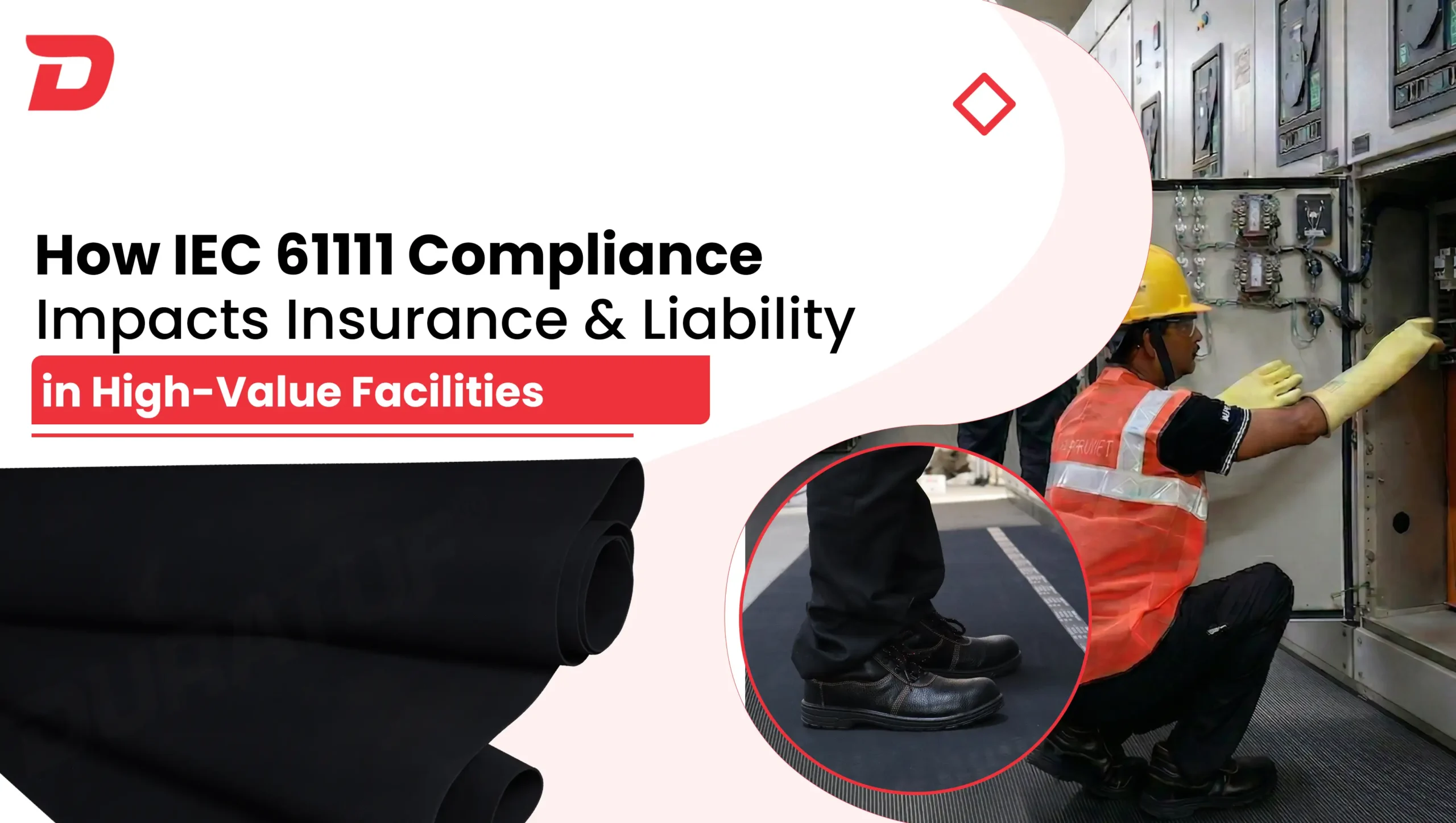
Something goes wrong on your site. A worker is hurt. Within hours, the investigation is underway and the first question is rarely about what happened. It’s about what was in place before it happened. Like- IEC 61111 compliance for your electrical mats, if you use them.
Insurers and regulators dig into compliance records fast. One unrated mat in front of a live switchboard. One re-test that was overdue. That’s enough. Liability lands on you, and the insurance you’ve been paying for may not respond the way you expect.
The numbers aren’t hypothetical. A single arc flash burn injury costs anywhere from $10,000 to $15 million USD. Hospitalization alone runs between $200,000 and $750,000 and that’s before legal fees and regulatory action even begin.
IEC 61111 compliance isn’t paperwork. It’s what separates a covered incident from one you’re defending on your own.
What is IEC 61111:2009?
IEC 61111:2009 is the international electrical insulating mats standard used around live electrical equipment. It covers voltage class ratings, dielectric test requirements, dimensional tolerances, and re-testing schedules.
The standard runs six voltage classes from Class 00, rated to 1,000V AC, up to Class 4 at 36,000V AC. Each class has a specific dielectric proof test that the mat must pass before it can be used in a rated environment. No test, no rating. No rating, no cover.
If your facility has high-voltage switchgear, transformer rooms, or electrical control panels, the mats deployed in front of that equipment need a verified IEC 61111 rating. Not a rubber grade. Not a thickness spec. A certified, marked, traceable rating.
A generic mat sitting in front of live equipment gives you no legal protection and no insurance footing whatsoever.
Why Does IEC 61111 Compliance Matter?
Most facility managers assume their insurance handles electrical safety liability. It does right up to the point where a compliance gap shows up in the post-incident review.
IEC 61111 compliance is referenced in commercial and industrial policy conditions across electrical contractor liability, premises liability, employer’s liability, and public liability cover. Particularly for:
- Electrical contractor liability policies
- Facility and premises liability cover
- Employer’s liability and workers’ compensation claims
- Public liability in facilities open to third-party contractors
Regulators work at the same angle. OSHA’s 2023 figures showed a 29% spike in lockout/tagout citations, with $20.7 million in penalties issued in a single year. Missing compliant safety equipment like high voltage electrical safety mats isn’t treated as an oversight. It’s treated as negligence and that shifts liability from the incident itself to whoever made the call not to maintain compliance.
Why Higher Voltage Areas are at Higher Risk?
High-value facilities aren’t risky because they’re badly run. They’re exposed because of the nature of the work.
In hospitals, data centers, utilities and industrial plants, maintenance gets done on live or partially energized equipment. There’s often no choice. That makes the risk of contact with energized parts continuous, not something that comes up once in a while. Arc flash incidents cause 7,000 burn injuries and roughly 400 deaths annually in the US. At higher voltages, the severity of any contact goes up sharply. It’s not a gradual curve.
On top of that, these facilities get walked regularly. Insurance surveyors, safety inspectors, third-party contractors – they’re on your site and they’re writing things down. An unrated mat not meeting electrical safety compliance flagged during a routine visit doesn’t go away. It sits in a report.
If an incident follows six months later, the workplace electrical safety standard report comes back.
Four Things Auditors and Insurers Will Check at Your Site
This part is not complicated. Most facilities get the initial setup right. Where things slip is in keeping it right over time.
Correct voltage class selection:
The insulating matting for electrical panels class has to match the maximum voltage at that work point – not the operating voltage, the maximum. Underrating a mat is non-compliance, full stop.
Certification and traceability:
Every compliant mat is marked with IEC 61111 class, manufacturing date, test confirmation. If an electrical safety mat on your floor has no marking, it’s non-compliant. Material and thickness are irrelevant without it.
Periodic re-testing:
Mats in active use need re-testing every 12 months. If an electrical mat passed its test three years ago and hasn’t been back since, it’s currently out of rubber insulating mats high voltage compliance regardless of condition. The test date is what matters, not when you bought it.
Documentation:
When an insurer or regulator asks for evidence, this is what you hand over: electrical mat insurance papers covering mat specs, test dates, installation locations. Without records, you have no evidence. And no evidence is the same as non-compliance in a dispute.
Duratuf IEC 61111:2009 Insulating Mats – Built for Compliance
Chasing down compliant mats from multiple suppliers and keeping certification records current is a task most procurement teams are quietly behind on. Duratuf IEC 61111:2009 insulating mats are manufactured and tested to the full standard such as class-marked, fully certified, and ready to hold up under insurer or auditor review.
The mat is available across voltage classes to suit your facility’s specific requirements. If your switchroom or panel layout needs custom dimensions, that’s covered too.
Specifying a compliant mat takes a few minutes. Defending why you didn’t, after something’s gone wrong, takes a lot longer.
Conclusion
An IEC 61111-rated mat does one thing a generic rubber mat never can: it gives your facility a documented, testable, legally recognised line of protection. In environments where a single incident can trigger seven-figure liability, that line is worth having.
Running without it doesn’t just put workers at physical risk. It puts facility owners, employers, and their insurers in a position that’s very hard to defend after the fact. Electrical insulating mats standard compliant matting, specified correctly, certified properly, and re-tested on schedule, takes that exposure off the table.
Compliance costs very little. An undefended liability costs a great deal more.