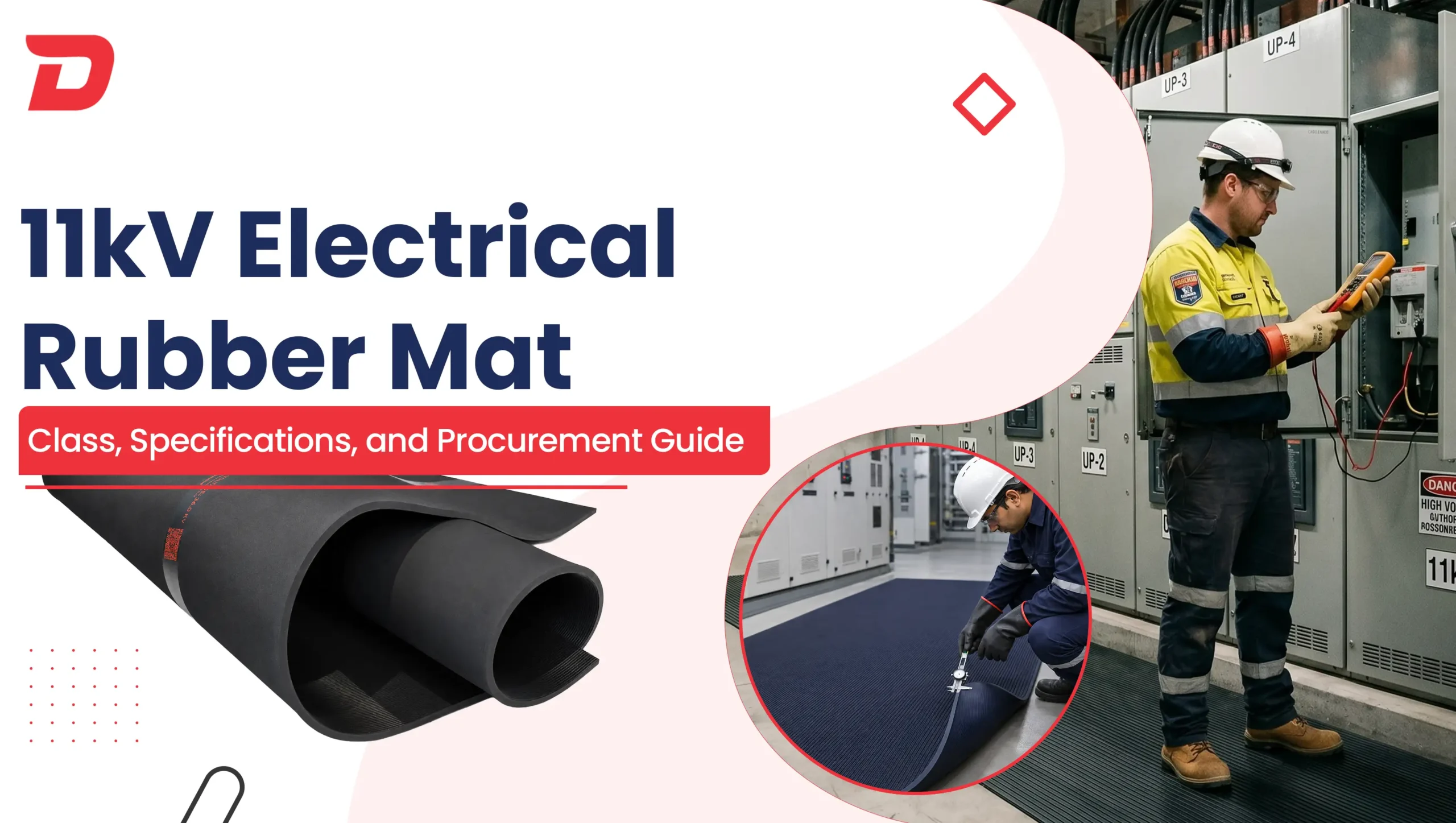
11kV is one of the most widely deployed distribution voltages in the world. It appears as the secondary voltage in 33/11kV, 66/11kV, and 132/11kV substation configurations across the United Kingdom, India, the Middle East, Australia, and most Commonwealth and developing markets. At industrial plants, commercial facilities, and utility substations, 11kV switchgear is present wherever medium-voltage power reaches end users. Selecting the correct 11kV insulating mat is the floor-level protection decision that separates a compliant installation from a legally indefensible one.
Three international standards govern the 11kV electrical rubber mat depending on where the installation is located. This guide covers the required voltage class, full specifications across all three standards, application zones, and the documentation to demand at procurement, whether the project is in Mumbai, Manchester, or Miami.
Which Class of Insulating Mat is Required for an 11kV System?
The question most EHS managers ask first: what class rubber mat for 11kV installations is required? The critical distinction to understand before answering is this — IEC 61111 Class 1 has a maximum use voltage of 7.5 kV. It does not cover 11kV systems. Class 2 is the minimum specification for any 11kV energized zone, and using a Class 1 vs Class 2 insulating mat is not a minor downgrade; it is the absence of certified protection at the operating voltage.
IEC 61111:2009 (International): An IEC 61111 Class 2 mat is required. It has a maximum use voltage of 17.0 kV — covering 11kV with a safety margin — an AC proof test voltage of 20.0 kV, and a withstand voltage of 30.0 kV. This is the standard for international projects, European and Middle East installations, and any project governed by an international EHS specification. A Class 2 insulating mat to IEC 61111 is the default for all projects where no jurisdiction-specific standard is stated.
IS 15652:2006 (India — BIS): A Class B insulating mat is required. The IS 15652 Class B mat carries a working voltage of exactly 11.0 kV, an AC proof test voltage of 22.0 kV, and a dielectric strength of 45.0 kV. It is required for projects under Indian regulatory jurisdiction: DISCOMs, state utilities, and facilities governed by the Electricity Act.
ASTM D178 (Americas): An ASTM D178 Class 2 mat is required. It has a maximum use voltage of 17.0 kV, an AC proof test voltage of 20.0 kV, and a dielectric voltage of 30.0 kV. This is the required standard for utility and industrial installations across North and South America.
All three produce a technically compliant mat for 11kV systems. They are not interchangeable on compliance documentation — confirm the required standard before ordering.
Technical Specifications
IEC 61111 Class 2 (IEC 61111:2009)
| Parameter | Specification |
|---|---|
| Maximum Use Voltage | 17.0 kV |
| AC Proof Test Voltage | 20.0 kV |
| Withstand Voltage | 30.0 kV |
| Recommended Thickness | 3.0 mm |
| Maximum Thickness Allowed | 8.0 mm |
| Mechanical Puncture Resistance (min) | 70 N |
| Slip Resistance (min) | 50 N |
| Working Temperature | -25°C to +55°C |
| Low Temperature Resistance at -25°C | No visible tears, cracks, or breaks |
| Flame Retardance | Does not catch fire |
| Acid and Oil Resistance | Mechanical test values not less than 75% of original |
| Ageing Resistance (70°C, 168 hrs) | Puncture resistance not less than 80% of original |
| Anti-Skid Design | Top fine ribbed, bottom textured |
| Standard Colour | Black |
IS 15652 Class B — XVOLT (Manufactured and Type-Tested to IS 15652:2006, ISI Marked, BIS Approved)
| Parameter | Specification |
|---|---|
| Working Voltage | 11.0 kV |
| AC Proof Test Voltage | 22.0 kV |
| Dielectric Strength | 45.0 kV |
| Recommended Thickness | 2.5 mm |
| Tensile Strength (min) | 15 MPa |
| Elongation at Break (min) | 250% |
| Leakage Current (max) | 10 mA |
| Insulation Resistance at 500V | 1,00,000 MΩ (min) |
| Working Temperature | -10°C to +55°C |
| Flame Retardance | Extinguishes within 5 seconds |
| Anti-Skid Design | Dotted top surface |
| Standard Colours | Black, Blue |
| Ageing Resistance (70°C, 168 hrs) | Tensile strength and elongation not less than 75% of original |
| Chemical Resistance (acid, alkali, oil) | Tensile strength and elongation not less than 80% of original after exposure |
ASTM D178 Class 2 (Americas)
| Parameter | Specification |
|---|---|
| Maximum Use Voltage | 17.0 kV |
| AC Proof Test Voltage | 20.0 kV |
| Dielectric Voltage | 30.0 kV |
| Recommended Thickness | 6.4 mm |
| Tensile Strength (min) — Type I | 4.83 MPa |
| Elongation at Break (min) | 250% |
| Moisture Absorption (max) — Type I | 1.5% |
| Ageing Resistance (70°C, 168 hrs) | Tensile strength not less than 50% of original |
| Anti-Skid Design | Top fine ribbed, bottom textured |
| Standard Colour | Black |
Two points worth noting when reading these tables together. IS 15652 Class B carries a dielectric strength of 45.0 kV — higher than the 30.0 kV withstand of both IEC 61111 Class 2 and ASTM D178 Class 2. This reflects the Indian standard’s different design basis, not a directly comparable product advantage. ASTM D178 Class 2 also specifies a 6.4 mm recommended thickness, more than double the IEC 61111 Class 2 recommendation of 3.0 mm, reflecting different mechanical design philosophies. Specify based on the standard that governs the installation, not based on dielectric voltage or thickness comparisons across standards.
Where 11kV Electrical Rubber Mats Are Installed
11kV is a step-down voltage, appearing at the output of 33/11kV, 66/11kV, and 132/11kV transformers globally. The mat requirement applies to every zone where operators work in proximity to energized 11kV equipment.
- 11/0.4kV distribution substations: The rubber mat for 11kV substation installations is the most common application worldwide. The 11kV switchgear bay, transformer bay, and LV distribution panel room all require independent mat coverage. A dedicated 11kV switchgear mat at the panel face and a rubber mat for 11kV transformer bays are both mandatory — the transformer bay is the zone most frequently missed during site planning.
- Industrial HT panels and MCC rooms: Manufacturing, petrochemical, food processing, and water treatment plants commonly receive 11kV supply. An 11kV panel rubber mat is mandatory at every HT control panel, motor control centre, and metering cubicle where operators access live 11kV equipment. The electrical panel mat for 11kV zones must cover the full operator standing area, not just the front panel face.
- 11kV switchboard rooms: Commercial buildings, hospitals, data centres, and large retail facilities receiving 11kV supply require 11kV switchboard matting across all live panel operating faces. In UK and European markets, “11kV switchboard mat” and “switchboard matting” are the standard procurement terms for this application, reflecting the legacy of the BS921 standard that IEC 61111 has since replaced.
- Bus bar sections: Any accessible area with live 11kV bus bars, during routine switching operations or maintenance access, requires rated mat coverage underneath.
- Renewable energy step-down points: Wind and solar farms collecting generation at 11kV before stepping up to transmission voltage require IEC 61111 Class 2 coverage at all internal 11kV switching and protection points.
- Generator rooms and lift machine rooms: Standalone 11kV generation, including large diesel generators and HV lift motor control, requires compliant mat coverage at all energized terminals and control panels.
- HT metering and testing laboratories: High-voltage test environments and utility metering rooms at 11kV fall under the same mat requirement. A dielectric mat 11kV rated — IEC 61111 Class 2 or IS 15652 Class B — provides the required floor insulation for these precision working environments.
The mat addresses step-and-touch potential, not just direct contact. Any area where a ground fault could energize the floor surface, or where an operator bridges a potential difference across their body, qualifies as a mat zone under all three standards.
11 kV Insulating Mat Standard Sizes & Thicknesses
IEC 61111 Class 2
| Class | Recommended Thickness | Standard Width | Standard Length | Weight per Roll |
|---|---|---|---|---|
| 2 | 3.0 mm | 1.0 m | 10.0 m | 40 kg |
Customizable up to 8 mm thickness and 1,220 mm (4 ft) width. Dark grey colour available subject to order feasibility. Tolerance: ±10% on thickness, ±2% on length and width.
IS 15652 Class B
| Class | Standard Width | Standard Length | Weight per m² |
|---|---|---|---|
| B | 1.0 m | 20.0 m | 4.0 kg |
IS 15652 Class B rolls are supplied in 20.0 m standard lengths — twice the length of IEC and ASTM standard rolls. This gives substantially more coverage per roll for large substation bays or bulk procurement. Custom lengths available on order. Tolerance: ±10% on thickness, ±20 mm on width and length.
ASTM D178 Class 2
| Class | Recommended Thickness | Standard Width | Standard Length | Weight per Roll |
|---|---|---|---|---|
| 2 | 6.4 mm | 1.0 m | 10.0 m | 92 kg |
Available in Type I (standard) and Type II with special properties: ozone resistance, flame resistance, or oil resistance, individually or combined. Standard supply is Type I unless specified. Maximum width 1,220 mm (48 in). Tolerance: ±0.8 to 1.2 mm on thickness.
Coverage calculation: For a typical 11/0.4kV substation, a standard 1.0 m wide IEC or ASTM roll of 10.0 m covers the switchgear bay, transformer bay, and bus bar section in a single-transformer layout. One IS 15652 Class B roll of 20.0 m covers the same with 10+ metres available for metering areas and additional zones. For non-standard bay widths, custom roll widths up to 1,220 mm are available across all three standards.
Certifications and Compliance Documentation
For IEC 61111 Class 2 mats, demand:
Type Test Certificate: Must explicitly reference IEC 61111:2009 and Class 2. Tests must be conducted at an accredited laboratory (NABL or an internationally recognized equivalent). A generic “electrical insulating mat test report” without the standard and class designation does not constitute compliant documentation.
Slip and Puncture Resistance Results: IEC 61111 specifies slip resistance minimum 50N and puncture resistance minimum 70N. Request test data for both alongside the electrical results — a mat that passes electrical testing but fails mechanical minimums is non-compliant under the standard.
Product Traceability: Each roll must carry a label with dimensions, voltage class, and a traceable product code. This is essential for audit trails in post-incident investigations.
For IS 15652 Class B mats, verify the following before accepting delivery:
Type Test Certificate: Issued by a BIS-recognized test laboratory. Must explicitly reference IS 15652:2006 and Class B. A report citing only IS 15652 without the class designation does not confirm an 11kV rating.
ISI Mark: The mat must carry the ISI mark on the roll. The BIS license number must be traceable to the manufacturer’s certification. Verify on the BIS portal for any new or unfamiliar supplier.
Product Traceability Label: IS 15652 requires each roll to be labeled with product name, dimensions, working voltage (11kV), and product code. Any of these absent is a rejection trigger.
For ASTM D178 Class 2 mats, verify:
Type Test Certificate: Must reference ASTM D178 and Class 2. If Type II properties are specified (ozone, flame, or oil resistance), each sub-type must appear on the certificate individually — “Type II” alone is insufficient documentation for a safety procurement.
One universal rule: A type test certificate older than three years from the mat’s production date warrants a fresh batch certification request. Request the certificate date and the batch production date separately before accepting any high-value consignment.
Maintenance, Re-Testing, and Replacement of 11kV Electrical Mat
An insulating mat’s dielectric properties degrade in service through physical wear, chemical contact, heat cycling, and UV exposure. IEC 61111 specifies periodic re-testing for in-service mats; for high-voltage classes the standard interval is every six months.
Monthly visual inspection checklist:
- Cuts, punctures, or abrasion marks that break the surface layer
- Cracks along fold lines, common where mats are frequently rolled and unrolled
- Surface swelling or discoloration indicating chemical exposure outside the resistance rating
- Edge delamination
- Anti-skid profile worn below 50% of its original depth
Non-scheduled re-test triggers:
- Any incident in the mat zone: flashover, fault event, or ground event
- Visible physical damage of any type
- Confirmed or suspected chemical exposure outside the resistance specification
- Voltage class upgrade at the installation
Storage requirements:
- Store rolled, not folded
- Keep away from UV sources and ozone-generating equipment: welding stations, UV lamps, corona discharge equipment
- Use a horizontal storage rack; do not stack weight on rolled mats
- Maintain storage temperature between -10°C and +30°C
A mat that fails visual inspection or periodic re-test must be removed from service immediately. There is no field-repair option for a voltage-rated insulating mat.
Procurement Mistake of 11kV Electrical Rubber Mats
Using Class 1 at an 11kV installation. The consequences of getting the Class 1 vs Class 2 insulating mat decision wrong are severe. IEC 61111 Class 1 has a maximum use voltage of 7.5 kV — it provides no certified protection at 11kV. An operator standing on a Class 1 mat in an 11kV zone is effectively unprotected at fault conditions. Class 2 is the minimum specification for 11kV, without exception across all three standards.
Confusing “tested to 11kV” with “rated for 11kV systems.” A significant portion of products marketed as 11kV shock proof mats in the market are tested to an 11kV withstand voltage — not rated for use in an 11kV system. Under IEC 61111, a mat tested to an 11kV withstand voltage falls within the Class 0 to Class 1 range with a maximum use voltage between 1.0 kV and 7.5 kV. When specifying, always confirm the maximum use voltage of the mat, not the test voltage. The maximum use voltage must meet or exceed the system voltage of the installation.
Wrong 11kV rubber mat thickness at delivery. The correct 11kV rubber mat thickness depends on the applicable standard: IS 15652 Class B requires a minimum of 2.5 mm; IEC 61111 Class 2 recommends 3.0 mm with a maximum of 8.0 mm; ASTM D178 Class 2 recommends 6.4 mm. These are not interchangeable — thickness is embedded in each standard’s design basis. Verify with a micrometer at delivery. A mat below the minimum for its claimed standard is a rejection.
Using IS 15652 Class A at an 11kV location. When comparing 3.3kV vs 11kV insulating mat requirements, the voltage gap is a factor of more than three. IS 15652 Class A has a working voltage of 3.3 kV — placing it at an 11kV location is a safety failure of the same severity as using a Class 1 mat at a 33kV installation. The Class A mat physically resembles a Class B mat; documentation is the only way to distinguish them at delivery.
Accepting uncertified products marketed as shock proof. The procurement market for 11kV electrical safety mats contains a significant number of uncertified products that use generic dielectric rubber without a type test certificate. Descriptions like “shock proof,” “high voltage insulation mat,” or “dielectric mat” on a product listing are not compliance claims. Only a type test certificate referencing the correct standard and class constitutes documented protection at 11kV. No certificate means no verifiable protection at fault conditions.
Treating three standards as documentation equivalents. IEC 61111 Class 2, IS 15652 Class B, and ASTM D178 Class 2 are all technically suitable for 11kV systems. They are not interchangeable on a compliance document. A project specifying IEC 61111 cannot be signed off with IS 15652 certification, regardless of whether both mats are electrically capable at 11kV.