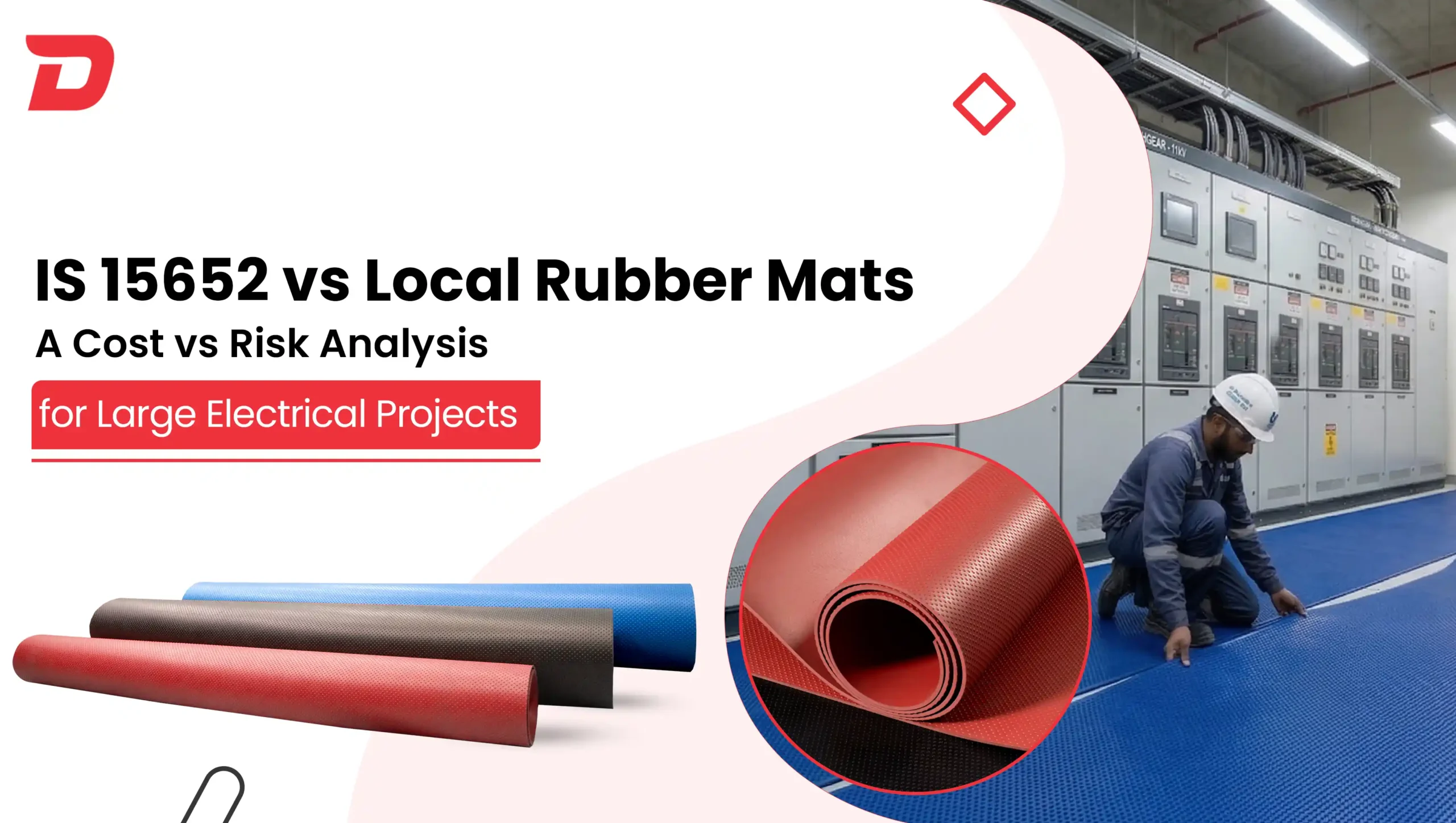
End of the financial year…tight budget? IS 15652 vs local rubber mats- which one will you choose in this situation?
Are you going to settle for a non-certified mat at a lower price, or choose a certified IS 15652 insulating mat with a proven record of ensuring workplace safety?
Well, protective equipment should not be a liability. It should do its best to protect the workers and minimize medical emergencies.
Understanding IS 15652 Certified Insulating Mats
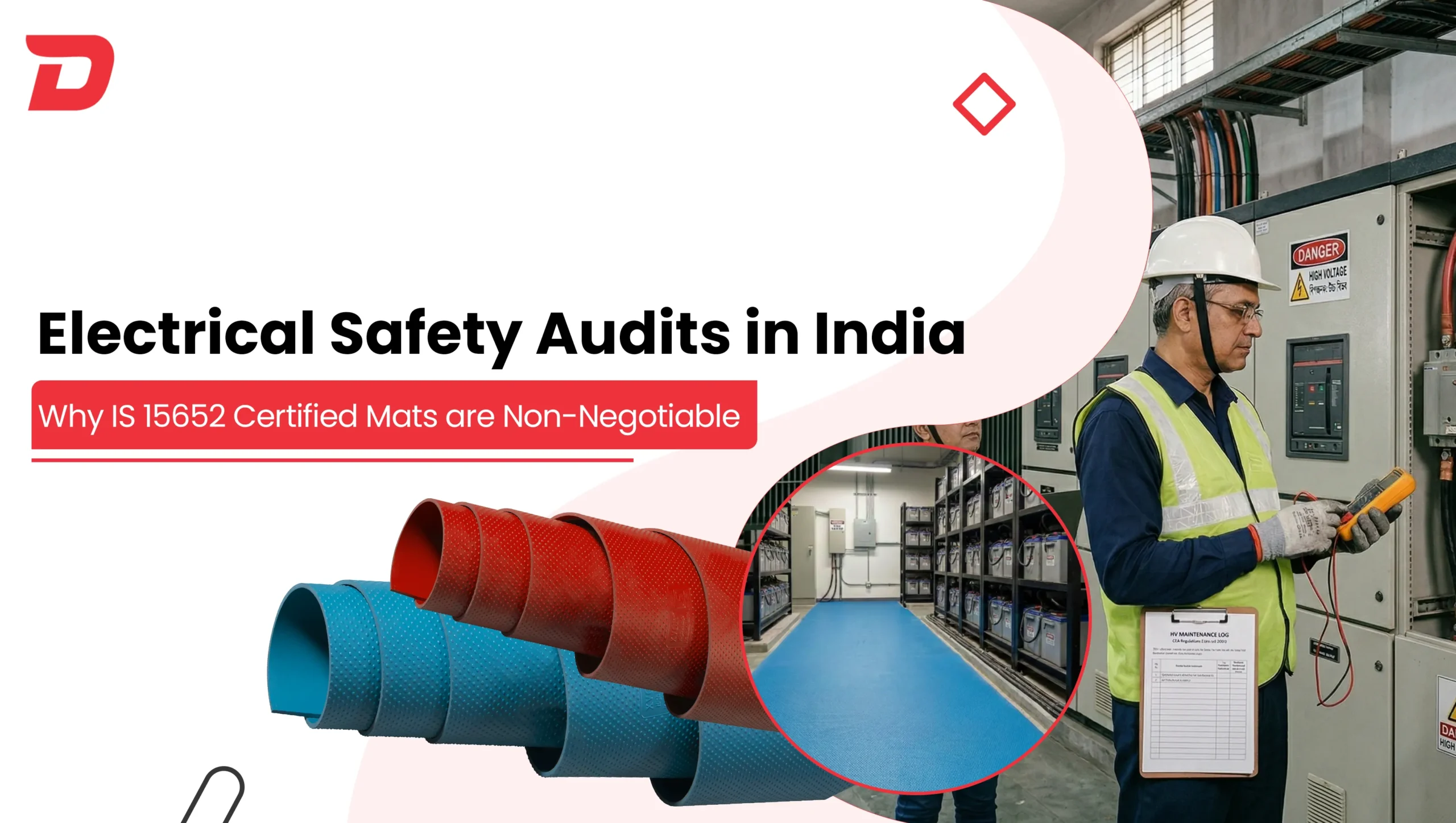
The Duratuf XVolt electrical insulating mats are IS 15652 certified. They adhere to IS 15652:2006, a standard set by the Bureau of Indian Standards (BIS). However, IS 15652-compliant insulating mats are classified into three classes: Class A (3.3 kV), Class B (11 kV), and Class C (33 kV). They are installed near electrical panels, switchgears, transformers, generators, and other high-voltage risk zones.
What Are Local Rubber Mats?
Local rubber mats are usually not compliant with industrial standards, such as IS 15652:2006. They are not certified and are sourced from unreliable suppliers. In addition, they are cheaper than certified rubber mats.
Key Differences: IS 15652 vs Local Rubber Mats
Here is a comparison between certified vs uncertified or local IS 15652 electrical rubber mats:
|
Feature |
IS 15652 Certified Mats |
Local Rubber Mats |
|---|---|---|
|
Safety Standard |
Compliant to the IS 15652:2006 standard |
Not compliant to the industrial standard |
|
Electrical Insulation |
Tested dielectric strength, AC proof voltage, and working voltage ratings |
Not verified |
|
Quality Control |
Strict quality control across each batch |
Variable quality |
|
Certification |
Tested and certified with proper markings |
Non-certified |
|
Reliability |
High reliability |
Uncertain performance |
IS 15652 vs Local Rubber Mats: Cost Comparison
Many buyers often overlook this simple calculation when deciding on IS 15652 vs local rubber mats. IS 15652 insulating mats have been tested for their insulating properties. As a result, they provide consistent security for workers operating at high voltages. Although their upfront costs may be high, they have a long service life and require minimal maintenance costs. Thus, they are cost-effective in the long run.
However, this is where local rubber mats lose the battle against IS 15652. As they lack adequate insulation in high-voltage risk zones, they often experience premature breakdowns. Although they have lower upfront prices, you will have to pay for frequent repairs or replacements. In addition, using local rubber mats can result in significant penalties during safety audits.
Safety Risks of Using Non-Certified Insulating Mats
Non-certified insulating mats put your workers as well your reputation in the market at risk. Here are the safety risks:
-
Inconsistent electrical insulation specifications: Industries do not prefer local mats over certified insulating mats due to their inconsistent performance. Their dielectric strength, working voltage range, and AC-proof voltage do not meet industry standards.
-
Increased risk of electric shocks: Non-certified insulating mats fail to protect you from electric shocks, arc flashes, electrocution, current leakage, and other electrical hazards.
-
Elevated risk of physical accidents: Another reason why industries never choose non-standard mats when it comes to standard vs non standard insulating mats is because of their surface texture. They do not come with a dotted surface texture, unlike IS 15652 mats. Due to the lack of anti-skid properties, there is more slipping and falling during movement.
-
More medical emergencies: Burns, injuries due to physical accidents, numbness, or even immediate death are common consequences of electrical accidents.
Compliance Risks in Large Electrical Projects
You will face these consequences if you do not comply with the industrial safety standards:
-
Safety audit failures: If your mat’s specifications do not meet industrial safety standards, you will fail the safety audits.
-
Penalties: If you choose to purchase local rubber mats in accordance with IS 15652, you may be penalized during audits.
-
Legal problems: If there are any electrical accidents in your workplace, you can face lawsuits and other legal issues.
-
Project delays: Ongoing legal issues stemming from electrical accidents may result in your workplace being temporarily or permanently shut down.
-
Reputation damage: Using non-certified mats, putting your workers at risk, legal issues, and non-compliance can damage your reputation in the market.
Why are certified insulating mats preferred in electrical projects?
Why do IS 15652 certified mats always win in the IS 15652 vs local rubber mats battle? Here are the reasons why:
-
Guaranteed electrical safety: When it comes to IS 15652 vs local rubber mats, industries always prefer IS 15652 mats as they pass all the tests as per the industrial standards.
-
Quality assurance: Each batch of IS 15652 insulating mats undergoes rigorous quality control.
-
Stay audit-ready: As they are certified and compliant, they can easily pass electrical safety audits.
-
Boosts efficiency: Workers operating in high-voltage risk zones feel valued and secure after you install certified insulating mats.
-
Safe and Reliable: Industries prefer IS 15652 certified mats when it comes to IS 15652 vs local rubber mats, as they are sourced from reputable suppliers. They are compliant, durable, and long-lasting.
Conclusion
In the IS 15652 vs local rubber mats battle, IS 15652 insulating mats always win. It is because they are certified, compliant with industrial standards, and audit-ready. Installing non-certified insulating mats can put your workers at risk and expose you to legal issues, penalties, and other consequences.
Reach out to us to get certified XVolt electrical insulating mats with ISI markings on every meter!