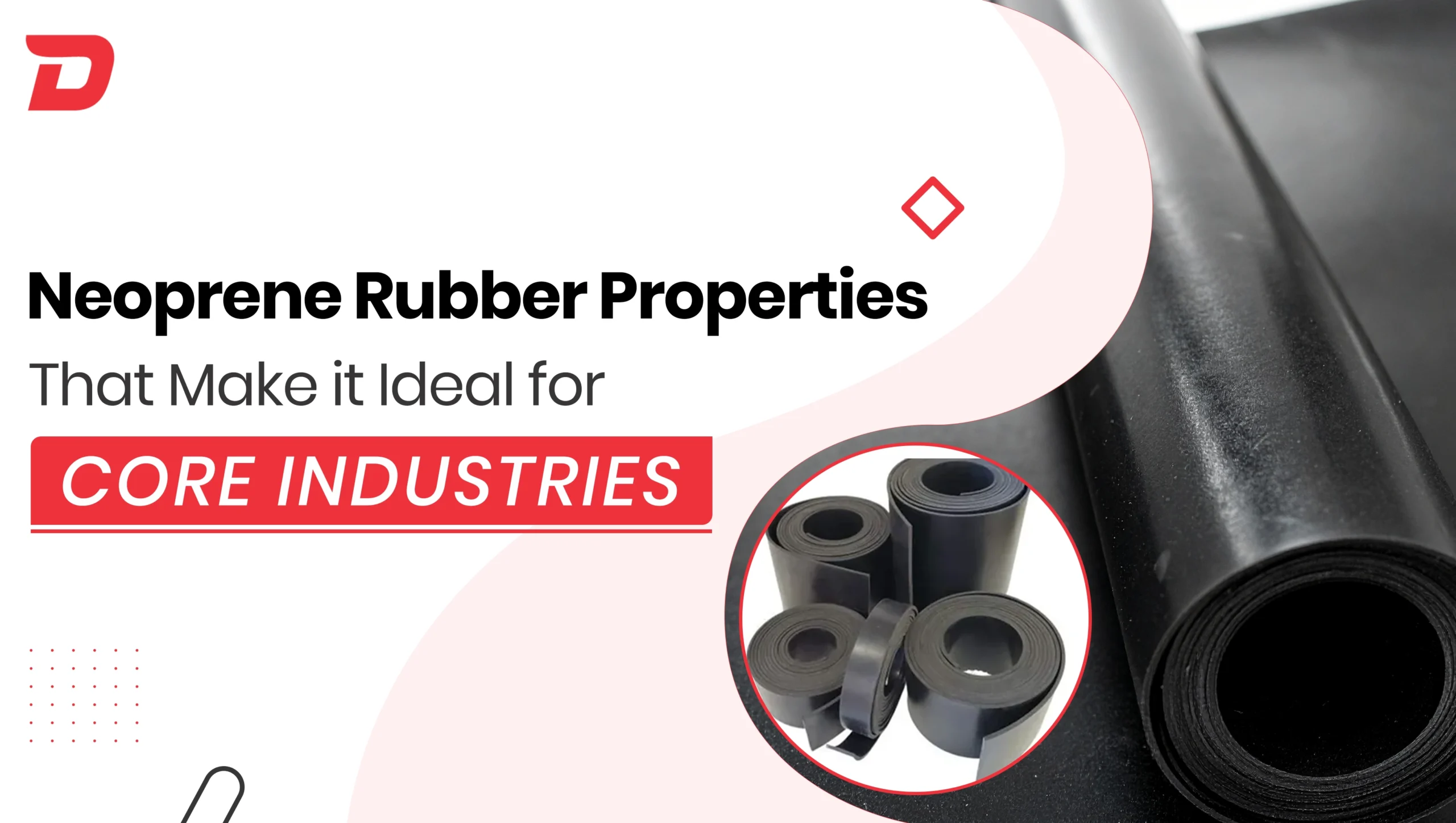
In this blog, we are going to discuss the properties of Neoprene rubber that make it a must-have in the core industries of the world. We will start by breaking down its composition to you and later focusing on its properties. Furthermore, we will also provide you with a brief on how these properties are to be maintained.
What’s the reason behind the hype of Neoprene rubber in the core industries? Is it because of Neoprene rubber properties?
What makes Neoprene rubber shine through light-duty and heavy-duty industrial applications?
In this blog, we are going to explore the following topics:
- Breaking Down “Neoprene” Rubber for You: Composition and More
- Which Neoprnee Rubber Properties Make Them Mark High Demand in the Core Industries?
- How to Keep these Neoprene Rubber Properties as They Are?
- Summary
- FAQs
Breaking Down “Neoprene Rubber” for You: Composition and More
The chemistry enthusiasts also call Neoprene “2-chloro-1,3-butadiene”.
Neoprene is a polymer of Chloroprene. The polymerization is done with the help of a free-radical emulsion. However, the polymer chains further undergo cross-linking to get the required characteristics and attributes. As the monomer of Neoprene is Chloroprene, people also tend to call it Chloroprene rubber.
Neoprene is a polymer of Chloroprene, and the Neoprene structure has a chlorine atom. It is highly electronegative, which strengthens the Neoprene properties such as resistance against heat, oil, ozone, and others. Thus, it has higher chemical stability.
Which Neoprene Rubber Properties Make Them Mark High Demand in the Core Industries?
1. Tensile Strength & Elongation at Break
Tensile strength and elongation at break are the most important Neoprene properties for determining its durability. The tensile strength of Neoprene sheets ranges from 4 MPa to 10 MPa. In addition, its elongation at break ranges from 200% to 350%. These Neoprene rubber properties depend on the variant of the Neoprene sheets.
How they help:
These Neoprene rubber properties are suitable for window seals, gaskets, o-rings, and elevator astragals that are common in the construction industry.
2. Hardness
Unlike other Neoprene rubber properties, the hardness value of all the variants, i.e., Neo65 Lite, Neo60 X, Neo65 Pro, and Neo65 Max, is the same. They have a hardness of 65 ± 5° Shore A.
How it helps:
These Neoprene rubber properties make them ideal for applications such as sealing, gaskets, and flooring in heavy-duty industries.
3. Specific Gravity
The specific gravity of Neoprene sheets ranges from 1.35 ± 0.05 to 1.45 ± 0.05 (as per the variant). Neoprene is a polymer of Chloroprene monomers. The specific gravity ensures its formulation, filler content, and quality.
How it helps:
It is used for applications such as hose covers, shock absorber seals, and other components in the automotive industry.
4. Temperature Resistance
Depending on the grade, the temperature resistance of the Neoprene sheets ranges from -30 degrees to +100 degrees centigrade. As a result, they do not get damaged in extreme heat or get brittle and crack in extreme cold.
How it helps:
They are used for engine gaskets, seals, weatherstripping, cable jackets, and more in the core industries.
5. Soundproofing
Soundproofing is one of the Neoprene rubber properties that is getting its share of acknowledgment in recent times. Neoprene rubber reduces the intensity of vibration and noise generation.
How it helps:
These Neoprene properties are best-suited to reduce noises and vibration during machine operations in the manufacturing industry. On the other hand, they are also used in recording studios for soundproofing.
6. Water Resistance
Among the Neoprene rubber properties, its water resistance property is worth mentioning. It does not swell with the absorption of water in the Neoprene structure.
How it helps:
Owing to its water resistance, Neoprene rubber has extensive applications in the marine industry. They are used to make dock bumpers, marine decking, wetsuits, and more.
7. Chemical & Oil Resistance
Neoprene rubber sheets have good resistance against a wide range of acids, alkalis, and solvents. Besides, they are resistant to petroleum-based oils and greases.
How they help:
These Neoprene properties are helpful for tank linings, hoses for fuel lines, and more in the chemical processing and oil & gas sectors.
8. Impact Resistance
This is one of the interesting Neoprene properties. They can dissipate energy or absorb it in case of sudden shocks or impacts. Besides, the Neoprene rubber sheets come in different thicknesses, ranging from 2 mm to 12 mm.
How it helps:
Cushioning and impact resistance- these Neoprene properties make them ideal for making padding and protective gears for sportswears. Besides, they are used for linings and padding in the steel industry.
How to Keep these Neoprene Rubber Properties as They Are?
To keep the Neoprene properties intact, you should make sure to take care of and maintain their condition.
- You should get rid of dust, dirt, or grease accumulation from the Neoprene rubber product.
- Using them for extreme operational temperatures can hamper their elasticity and cause deformation.
- Subjecting your Neoprene rubber to harsh chemicals for cleaning or abrasive applications can hamper the Neoprene rubber properties, and it might not be fit for further use.
- Excessive physical stress can lead to premature breakdown. Hence, make sure you are choosing the right variant for your applications.
What we mean to say is that…
Neoprene rubber surely is meant for versatile industrial applications. It ticks all the boxes, starting from mechanical strength to resistance properties. Thus, they remain durable, effective, and offer a long service life in core industries. Conduct periodic tests to check the Neoprene properties and repair or replace them immediately whenever you find any damage.
Talk to our experts to know more about the Neoprene properties!
FAQs
Which is better Neoprene or rubber?
That depends on your applications. Neoprene or polyChloroprene rubber has better resistance to oil, chemicals, and different temperatures. Whereas, natural rubber is known for its sustainability and mechanical strength.
What is Neoprene rubber sheet used for?
Neoprene structure formula is suitable for uses such as gaskets and seals, liners, and more. In addition, the preparation of Neoprene rubber also ensures its efficiency in other applications, including flooring, padding, curtains, and others.
What is the price of 10mm Neoprene rubber sheet?
The Neoprene rubber density and other dimensions influence the price. You can reach out to our experts to know the further price breakdown.
What is Neoprene rubber gasket?
Neoprene formula makes it ideal for manufacturing gaskets. Owing to its resistance properties, it creates secure and durable seals in the industries.
What is the price of Neoprene rubber sheet 5mm thick?
The price of neoprene rubber sheets depends on many factors such as hardness, grades, size and density of the rubber sheets. Please reach out to our expert for accurate price of neoprene rubber based on your requirements.