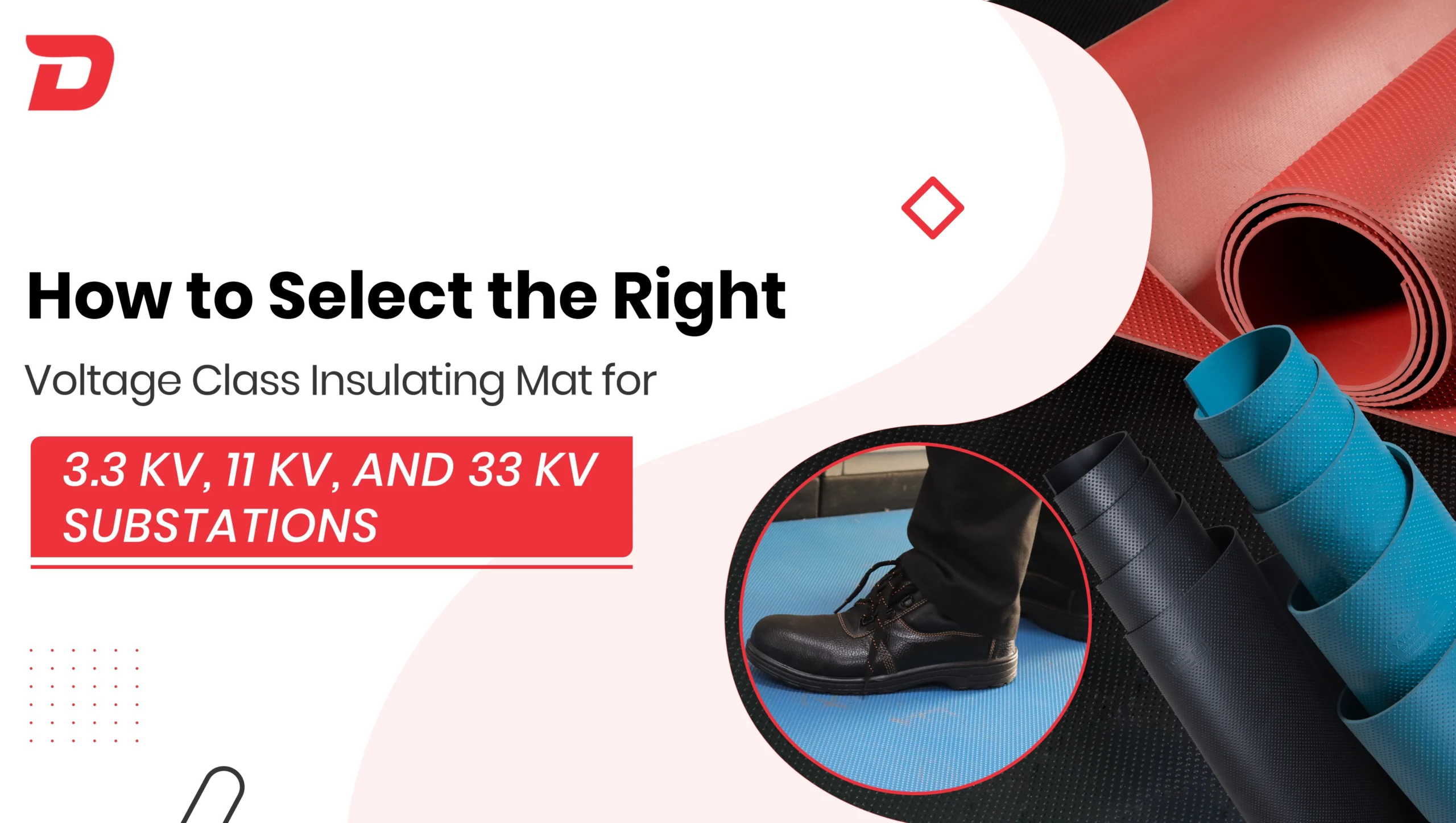
An electrical mat is a necessary piece of safety equipment in high-voltage areas. Choosing the right voltage class insulating mat for substations of 3.3 kV, 11 kV, and 33 kV is crucial, as they are responsible for protecting the workers from any electrical hazards. However, buying electrical insulating mats for substations can be confusing.
What is your reason? Inconsistent recommendations, interpretation of technical details, or lack of awareness? Whatever the reason is, we are here to help you make the right purchase decision with our guidelines.
Understanding Voltage Class in Electrical Insulating Mats
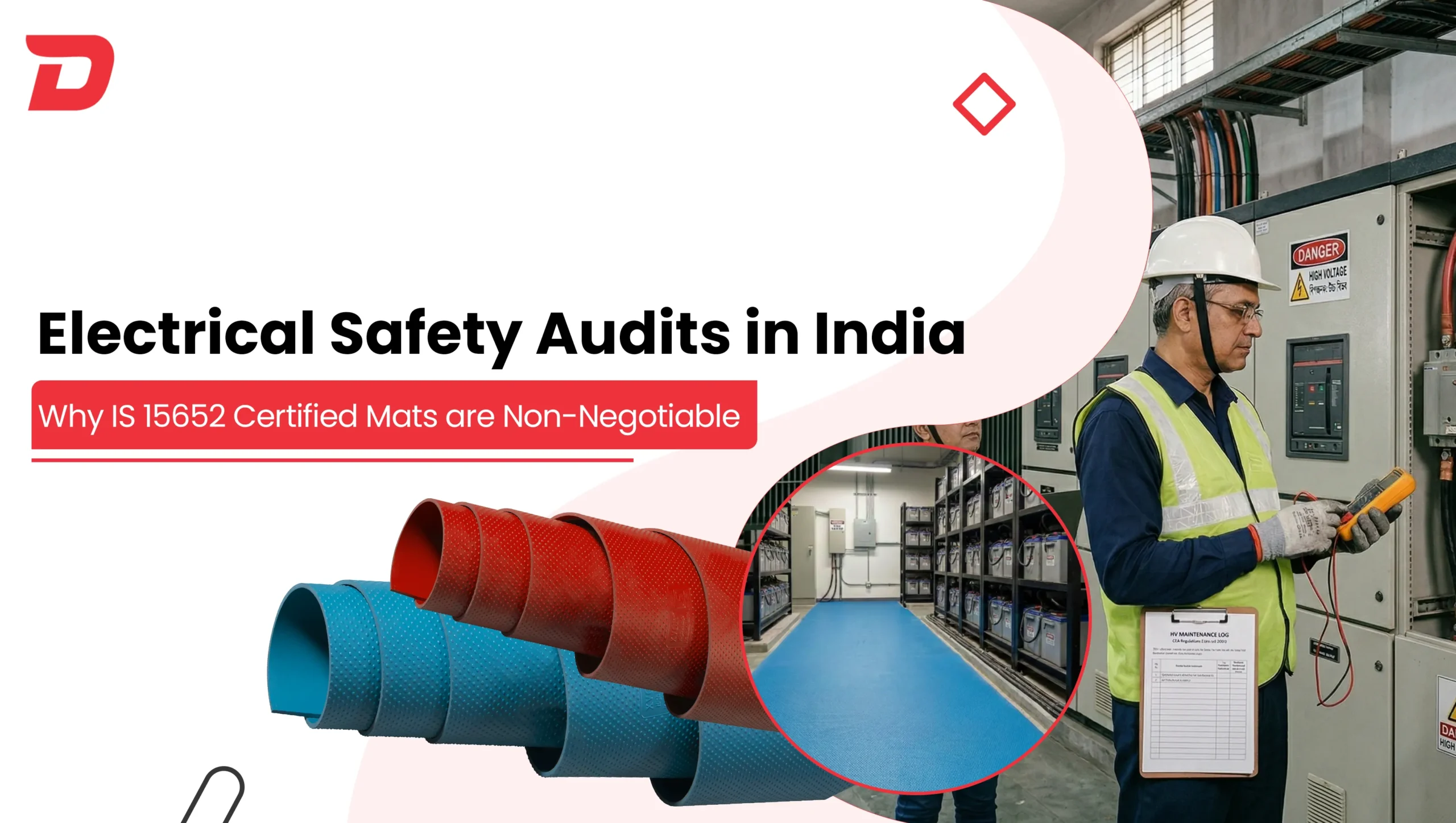
Voltage Class Insulating Mat for Substations: Electrical insulating mats are categorized into different classes. The IS 15652:2006 mats come in Class A (3.3 kV), Class B (11 kV), and Class C (33 kV). Each class is suitable for different working voltages.
Insulating Capability: Electrical insulating mats are non-conductive in nature. They have high dielectric strength and can withstand high voltages without breaking down.
Relationship between system voltage and insulation rating: You should install insulating mats with an insulation rating that suits your application voltage. Installing mats with lower ratings will break down and fail to protect you from electrical hazards.
Why Is it Important to Have the Correct Voltage Class Insulating Mat for Substations
3.3 kV, 11 kV, and 33 kV substations have multiple high-voltage risks due to loose connections, frayed wires, faulty systems, overheated machines, and others. As a result, electrical accidents such as short-circuits, arc flashes, current leakage, and others are quite common.
Choosing the correct voltage class insulating mat for substations will:
- Safeguard workers from such electrical accidents.
- Provide adequate thickness for your application, enhancing comfort and safety.
- Have a long service life for their appropriate electrical insulation properties (dielectric strength, AC proof voltage, and withstand voltage).
- Minimize the chances of workers getting burns and injuries.
Voltage Levels in Typical Substations
3.3 kV Distribution Substations
3.3 kV distribution stations are a low-voltage facility operating on 3300 volts or 3.3 kV electricity. It typically acts as a gap between two or more high-voltage substations (11 kV or 33 kV). Some high voltage areas here are 3.3 kV Vacuum Circuit Breakers (VCB) panel with in-comer and bus coupler units and transformers. IS 15652 electrical mat class A suits the bracket.
11kV Substations
Electricity is supplied to commercial buildings, residential distribution systems, and industrial facilities through 11 kV substations. IS 15652 electrical mat class B is commonly used in 11 kV substations. Class A mats are also occasionally used in lower voltage areas.
33kV Substations
The 33kV substations handle higher power loads and are used for regional power distribution, industrial zones, or infrastructure projects. 33 kV substations deal with the highest voltage range. Hence, buyers pick a Class C electrical insulating mat for the purpose. However, Class A and Class B mats can also be used depending on the voltage level.
Recommended Voltage Class Insulating Mat for Substations
| Class | Max Use Voltage | AC Proof Voltage | Dielectric Voltage | Standard Thickness |
|---|---|---|---|---|
| A | 3.3 kV | 10.0 kV | 30.0 kV | 2.0 mm |
| B | 11.0 kV | 22.0 kV | 45.0 kV | 2.5 mm |
| C | 33.0 kV | 36.0 kV | 65.0 kV | 3.0 mm |
Key Factors to Consider When Selecting Voltage Class Insulating Mat for Substations
Operating Voltage vs Safety Ratings
You should check that the operating or working voltage of your application does not exceed the safety rating of your insulating mat.
Switchgear Room Layout
Make sure that you get insulating mats with proper length and width as per the switchgear room layout. You can also get customized mats for narrower or wider high voltage areas in the substation.
Working Conditions in Substations
The 3.3 kV, 11 kV, and 33 kV substations might have exposure to oil, moisture, heat, and more. Buyers often forget to mention such details about the environmental conditions to the suppliers. As a result, they end up purchasing insulating mats that have no resistance to such conditions.
Mat Thickness and Durability
Each voltage class insulating mat for substations has a different thickness range. However, the recommended thicknesses for Class A mats are 2 mm, Class B is 2.5 mm, and Class C is 3 mm. You should get mats with adequate thickness and mechanical strength so that they are durable.
Certifications
Make sure you get all the test certificates that justify their specifications. They should also come with industrial safety standard compliance certificates. For Indian power facilities, accept an electrical mat only if it has an IS 15652 certification.
Key Locations Where Insulating Mats are Installed in Substations
- Transformer area
- Control panels
- Relay boards
- Switchgear rooms
- Circuit breakers, and more.
Common Mistakes When Selecting Insulating Mats for High Voltage Substations
1️. Choosing mats only based on price
Cheaper insulating mats can compromise the substation safety. Their specifications, including dielectric strength, AC proof voltage, or withstand voltage, may not be as per the industrial safety standards.
2️. Ignoring voltage class compatibility
People often install mats for lower voltages in high-voltage applications, which continues to put them at risk of getting exposed to electrical hazards. In addition, these mats tend to break down immediately with exposure to high voltages such as 3.3 kV, 11 kV, or 33 kV.
3️. Using low-grade rubber mats
Rubber flooring mats and insulating rubber mats are not the same. Using a low-grade rubber mat will not shield you from the high voltage risks.
4️. Not considering environmental exposure
You should use insulating mats with appropriate resistance properties as per the environmental conditions.
Conclusion
To choose the right voltage class insulating mat for substations of 3.3 kV, 11 kV, and 33 kV, you should know what you need. You should make sure that the insulating mat is suitable for your application voltage rating, environmental concerns, dimensions, and other properties.
Need more help? Talk to us!