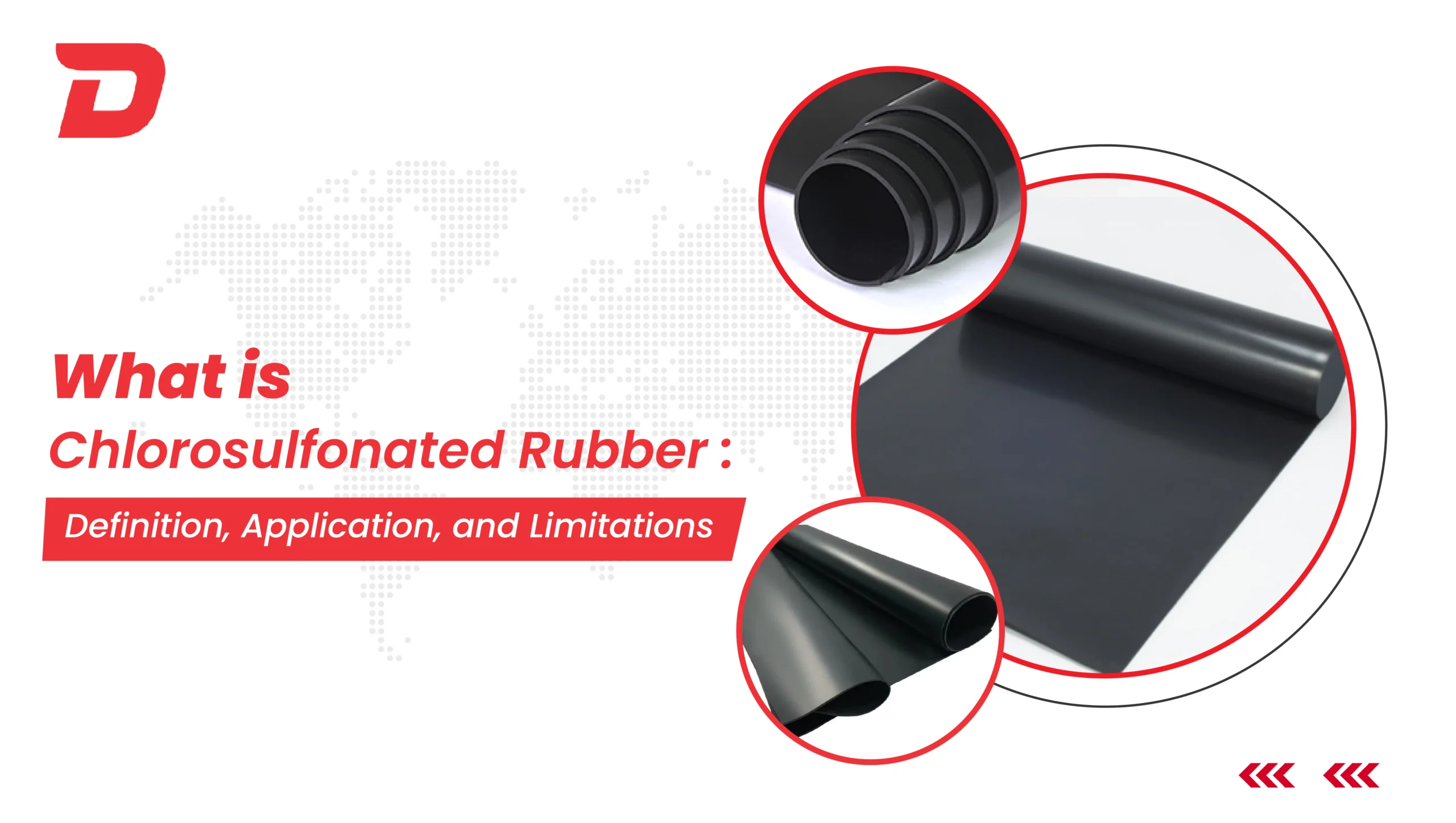
Have you ever come across the term ‘Chlorosulfonated Rubber’ when browsing through synthetic rubber sheets? Confused, did you leave the search and scroll through it quickly? What if we tell you that a Chlorosulfonated Polyethylene Sheet is one of the most popular rubber sheet types?
Yes. You have read it right. Cholorosulfonated rubber or CSM rubber is best known by its brand name- Hypalon. Now, you recognize?
In this blog, we will be talking about CSM rubber. This can be your next go-to buyer’s guide if you want to buy a Hypalon gasket sheet for your business. Our specialists have curated information that you need- no fillers! Come on, let’s go through!
What is Chlorosulfonated Rubber?
Chlorosulfonated rubber, known as CSM rubber and Hypalon rubber, is a synthetic elastomer made by treating polyethylene with chlorine and sulfur dioxide. Some buyers see it as an advanced version of Chloroprene (Neoprene) rubber, but with better features.
Hypalon rubber formulation has around 20% to 45% of Chlorine, attributing to its superior Hypalon rubber properties, such as:
- Ozone & UV Light Resistant: Prevents cracks and degradation in outdoor applications, better than EPDM or Neoprene
- Chemicals & Oils Tolerant: Ideal for contact with fuels, acids, and alkalis.
- Weather Extremes Withstanding: Performs well in both high and low temperatures between -30 and +130 degrees Celsius.
Note: Chlorosulfonated polyethylene sheet is marketed by the DuPont company under the brand name Hypalon. It is similar to the Neoprene sheets, which are originally called Chloroprene rubber.
Chemical resistant CSM rubber has versatile uses, mostly in challenging industrial environments.
Industrial Applications of the Chlorosulfonated Polyethelene Sheet
Industries like automotive, aerospace, chemical refining, and construction rely the most on Chlorosulfonated rubber for its supreme features. Below are the 7 typical applications of this synthetic elastomer:
1. Roofing membranes in UV and ozone-exposed areas :
Some places in the Gulf and Middle Eastern region are more exposed to UV rays than other parts of the world. Although EPDM rubber sheet is more popular for roofing applications, the roofer’s favorite may not suffice for these areas with extreme heat. Here, CSM-based roofing sheets are a more reliable option for roofing industrial warehouses to prevent UV-induced cracking. Some studies suggest that Chlorosulfonated rubber can tackle UV and Ozone rays for up to 15 years.
2. Chemical tank linings and duct covers :
CSM coating on steel storage tanks in fertilizer plants resists corrosion from phosphoric acid. This can be done by lining the industrial tanks with a Chlorosulfonated Polyethylene sheet of optimum thickness.
Apart from fertilizer plants, Hypalon is also used in wastewater treatment facilities and chemical storage yards to protect tanks, ducts, and ventilation systems from acid vapors and corrosive liquids.
3. Protective covers for marine and floating structures
Although Neoprene rubber sheet is used in marine environments, CSM delivers extra. Marine and floating structures that remain suspended in the sea get eroded quickly with the dissolved salts present in the water.
Chemical resistant CSM rubber is used in marine deck paints for fishing vessels operating in salt-heavy environments like the Arabian Sea or Pacific Ocean. Moreover, CSM sheets in inflatable dock fenders absorb vessel impact and resist marine growth.
4. Gaskets and seals in HVAC and outdoor units
Gaskets and seals prevent the free flowing of liquids or gases. A Hypalon gasket sheet is used in fuel transfer hoses for offshore oil rigs. These seals handle diesel and kerosene without softening or swelling.
It is used in rooftop HVAC systems, outdoor chillers and ventilation units as well.
5. Lining in flue gas or exhaust systems
Construction, chemical refining, or automotive industries involve the handling of hot flue gases. A general-purpose rubber sealing or even an NBR sheet sealing cannot handle the high heat of these gases and degrades, halting the operation. But not the Chlorosulfonated rubber sheets.
Common in power plants, cement kilns and boiler exhaust ducts, CSM rubber handles hot, chemical-laden flue gases without surface degradation.
- Marine Industry: Boat fabrics, life rafts, dock seals, etc.
- Construction: Roofing membranes, waterproof liners, etc.
- Chemical Processing: Hose linings, tank coatings, etc.
- Electrical: Outdoor cable sheathing, etc.
- Transport: Fuel hoses, gaskets, etc.
6. Chemical and acid splash barrier curtains
Acid and some chemicals have corrosive effects. They can be fatal to both humans and equipment. When safety is your priority, you must choose a Hypalon sheet. They are installed in metal plating shops, acid cleaning bays, and hazardous chemical zones as flexible protective screens for worker and equipment safety.
7. Industrial weatherproof expansion joints and bellows
Solar farms in high sunlit regions have expansion joints and cable sheathing that need extra care and protection. Here, Hypalon ensures flexibility and weather resistance in bridge joints, pipeline bellows and large-scale duct connectors. Especially those exposed to outdoor conditions year-round.
Chlorosulfonated rubber is such a superhero- does it mean that this synthetic rubber has no limitations? Every rubber sheet has some or the other limitations. For Hypalon, these are:
The Limitations of Chlorosulfonated Rubber
CSM rubber is versatile but not for every application. These are a few cases, you might rethink considering Hypalon as your fit:
- Higher cost: Chlorosulfonated rubber sheet price is more than that of natural rubber or Chloroprene rubber. Hence, the mighty Hypalon can pinch your pocket if you are using it on low-budget projects.
- Lack of consistency: The product is also called Hypalon electrical insulation sheet because of its ability to handle high temperatures, but not for too long. Silicone is always the best if you are looking for consistency in high-temperature environments.
- Lesser suppliers: With the elevated Chlorosulfonated rubber price, rubber sheet suppliers prefer not to deal with them.
- Processing difficulty: Since most rubber sheet suppliers do not have Cholorosulfonated rubber in ready stock, they face difficulty processing it. It increases lead and delivery time.
- Transparency
- High-quality products
- Tech-backed order management
- End-to-end customer services
Choose Duratuf for Quality-Assured Chlorosulfonated Rubber
Are you searching for Chlorosulfonated (Hypalon) rubber sheets from a reliable supplier? Your search ends here with us. Duratuf is a globally acclaimed rubber sheet supplier with 3793+ happy customers in more than 61 countries.