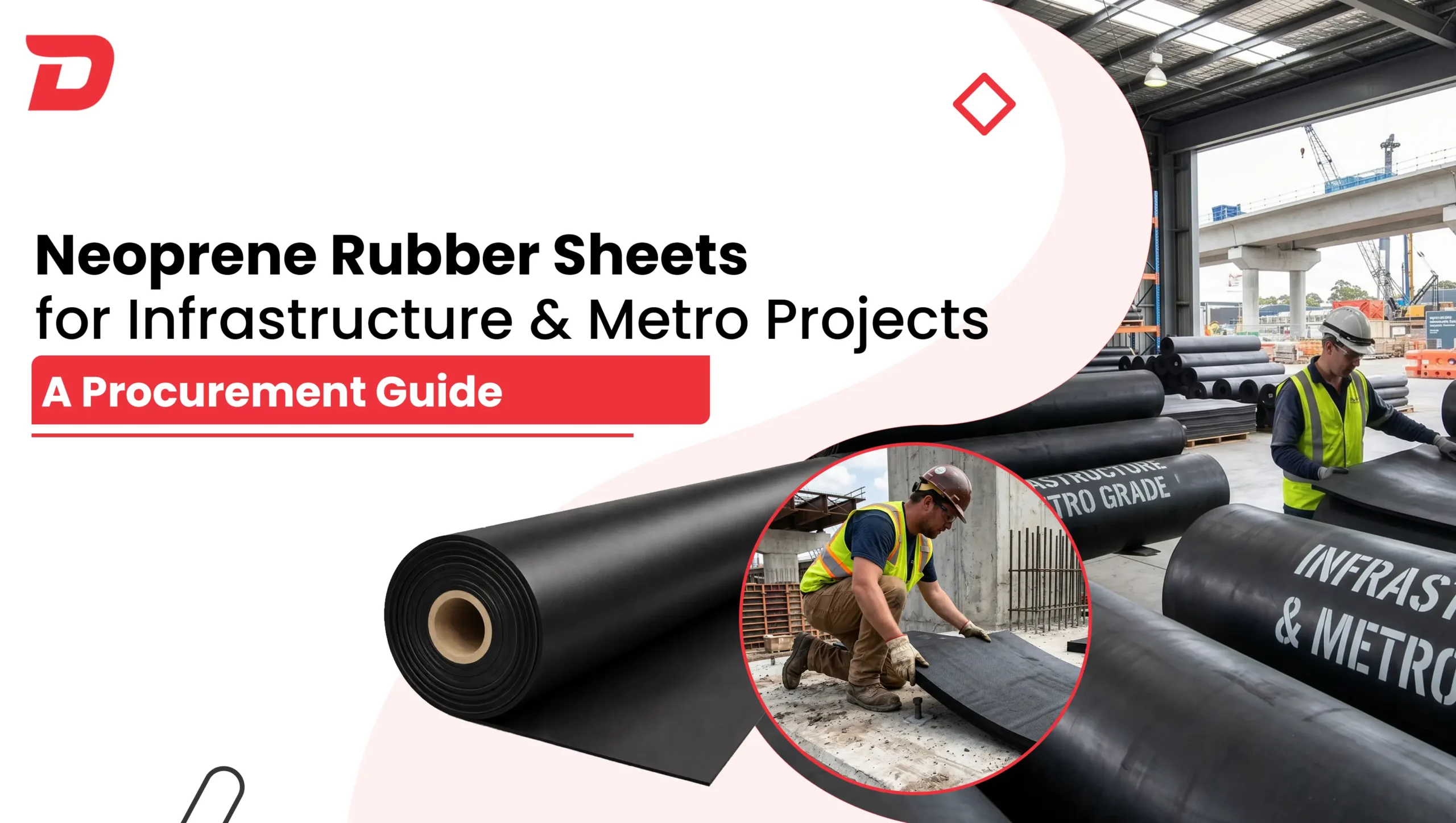
We’re sourcing elastomeric materials for a metro viaduct project – which rubber type holds up best, and how do we qualify a supplier?
If you’re an EPC contractor, procurement manager, or site engineer, you’ve probably had some version of this conversation. Maybe during a design review, maybe in a frantic WhatsApp message at 11 PM before a deadline. The question comes up constantly across metro corridors, bridge networks, highway flyovers and it almost never has a clean answer unless you know what to look for.
Neoprene rubber sheets sit in a strange procurement category. They’re not glamorous. Nobody writes case studies about them. But get the spec wrong, and you’re looking at bearing failures, leaking expansion joints, or vibration complaints from residents living 200 metres from a metro line. It becomes your problem fast.
Here’s what your team needs to know before placing an order.
5 Key Properties of Neoprene for Civil Infrastructure
Neoprene, the trade name for Chloroprene, isn’t cheap. That’s usually the first objection you’ll hear from someone trying to cut costs. And fair enough: there are cheaper rubbers on the market.
The problem is that infrastructure doesn’t give you many second chances. A bearing pad that fails on a bridge viaduct isn’t a warranty claim situation; it’s a structural investigation with names attached to it. Neoprene earns its price tag through what it doesn’t do: it doesn’t crack in ozone, it doesn’t soften badly in tropical heat. Additionally, it doesn’t creep permanently under sustained compressive load the way softer rubbers tend to.
In practical terms, it remains functional from roughly -40°C up to 120°C. That covers everything from a Himalayan mountain tunnel to an outdoor metro station in Chennai’s peak summer. It resists degradation from UV exposure, groundwater, oils, and mild chemical contact, all of which are routine in urban underground and coastal infrastructure environments.
The property that matters most for structural applications is compression set behaviour. Neoprene retains its original geometry under sustained load far better than alternatives like natural rubber. For a bearing pad or joint seal expected to perform over 30–50 years, that’s not a minor spec detail. It’s the whole ballgame.
Neoprene vs EPDM vs Natural Rubber for Infrastructure Use
There are really three materials that come up in infrastructure procurement discussions: neoprene, EPDM, and natural rubber. Here’s how they compare honestly.
| Property | Neoprene | EPDM | Natural Rubber |
| Temperature Range | −40°C to +120°C | −50°C to +150°C | −30°C to +80°C |
| Ozone Resistance | Excellent | Excellent | Poor |
| Load-Bearing | High | Medium | High |
| Chemical Resistance | Good | Good | Low |
| Cost | Medium-High | Medium | Low |
| Infrastructure Suitability | Ideal | Good for sealing | Limited outdoor use |
EPDM rubber is actually a fine material for certain sealing applications, and it handles thermal extremes well. But its lower load-bearing capacity is not the right call for structural bearing pads. Natural rubber is strong under load but degrades badly outdoors; you simply can’t expose it to ozone long-term without significant deterioration.
For anything involving simultaneous mechanical loading and outdoor or underground environmental exposure, neoprene is the combination that holds up. That’s why IRC:83, IS 11328, and RDSO specifications point toward it.
Core Applications in Metro Rail & Infrastructure Projects
Choloroprene, commonly known as Neoprene, is favored in construction projects for their vibration dampening and impact resistance properties:
1. Bearing Pads for Bridges and Metro Viaducts
Bearing pads sit between a bridge superstructure and its substructure between the deck and the pier cap, essentially. Their job is to transfer loads while allowing controlled movement from thermal expansion, live traffic loads, and seismic drift.
Without them, stress concentrations build up at the interface. Eventually something cracks, whether that’s concrete, welds, or connection hardware. Neoprene bearing pads absorb and distribute that movement gradually and predictably. On metro viaducts specifically, where trains run at speed with high axle loads and you’ve got cyclic loading patterns repeating thousands of times daily, the compression set performance matters enormously.
2. Expansion Joint Seals
Road decks, flyovers, metro station platforms, anywhere two structural elements meet with a designed movement gap, you’ve got an expansion joint that needs sealing. Neoprene is standard here because it accommodates that cyclic open-and-close movement across seasons without hardening, cracking, or losing adhesion.
Polyurethane sealants are sometimes used for smaller joints, but for larger modular expansion joints in heavy-traffic environments, neoprene-based profiles remain the dominant material.
3. Vibration Isolation Pads for Rail
This one often gets underestimated at the spec stage. Metro trains generate significant ground-borne vibration not always felt dramatically at the surface, but enough to cause noise complaints, minor structural disturbance, and long-term fatigue in adjacent buildings.
Neoprene isolation pads installed under rail tracks and equipment mounts dampen vibration transmission into the structure. Getting the specification right here means matching pad hardness and geometry to the actual dynamic load profile and frequency range of the line; it’s not a one-size situation, and suppliers who claim otherwise are probably selling you a catalogue item that wasn’t engineered for your application.
4. Tunnel Waterproofing
In cut-and-cover and bored metro tunnels, neoprene sheets serve as primary waterproofing membranes against hydrostatic pressure and groundwater infiltration. CR-W grade neoprene is specifically formulated for this because it has better water and chemical resistance, with enough flexibility to handle the thermal movement underground environments produce.
5. RDSO-Compliant and Laminated Pads
For Indian Railways and metro projects, RDSO approval is not optional but it’s a contract requirement, and it means the product has been tested against specific hardness, elongation, and compression set values defined by the organisation. Always get current approval documentation, not a reference to previous certification that may have lapsed.
Laminated elastomeric bearing pads alternating neoprene and steel plate layers vulcanised together are specified for large-span bridges and elevated metro corridors where plain pads would fail under the combined vertical load and rotation demand. The steel reinforcement restrains lateral bulge under compression, significantly increasing the allowable load capacity.
Technical Specifications: What Procurement Teams Must Verify
This is where many procurement teams leave money and assurance on the table. Specifying “neoprene rubber sheet, 12mm, black” is not a specification. It’s a description of a colour and a dimension. A proper procurement document for infrastructure-grade neoprene should contain:
- Hardness (Shore A): Typically 50–70 Shore A for bearing pads; verify as per IS 3400 / ASTM D2240
- Tensile Strength: Minimum 10–15 MPa depending on grade and application
- Elongation at Break: ≥350% for elastomeric pads
- Compression Set: ≤25% after 22 hours at 70°C (IS 3400 / ASTM D395)
- Ozone Resistance: No cracking after exposure per ASTM D1149
- Thickness Tolerance: ±0.5 mm for standard sheets; tighter for laminated pads
- Density: 1.23–1.25 g/cm³ for general neoprene grades
Every one of these should be backed by an NABL-accredited lab test report from the actual production batch, not a historical type-approval certificate. Rubber compounds can vary between batches if a supplier changes raw material sources.
The Procurement Checklist for Neoprene Rubber Sheets
There’s no shortcut here. Here is the checklist:
- Compound and grade verification: Confirm the neoprene grade matches your specification. CR-W for waterproofing, standard CR grades for mechanical applications. Ask for the compound data sheet.
- Accredited test reports: Request NABL lab reports covering all the mechanical parameters listed above. Reports from the supplier’s own in-house lab, without third-party verification, are not sufficient for infrastructure use.
- Batch consistency: A single passing test report tells you exactly one thing: that one batch cleared the bar. What it doesn’t tell you is whether the compound is stable across production runs. Raw material sourcing changes, shift supervisors change, and rubber compounding is not a perfectly controlled process at most facilities. Ask for QC data across several batches — three minimum, five if the supplier has it. If they push back on sharing that, that’s your answer.
- RDSO documentation: Ask for the actual certificate, check the date, and cross-reference it against the specific grade and dimensions you’re ordering. Approvals aren’t always blanket, a certificate for 50 Shore A pads at 25mm thickness may not cover what you’re specifying.
- Custom sizing: Most infrastructure drawings don’t land on catalogue dimensions, and suppliers who can only cut from standard sheet stock will either tell you they can’t do it or, worse, quietly supply something close enough and hope nobody checks. Ask directly, get a straight answer
- Lead times: Laminated pads take longer because of the vulcanization cycles involved. A verbal “four to six weeks” from a sales contact is not a delivery commitment. If the PO doesn’t have a confirmed date, you don’t have a delivery date.
- Technical support: Send your neoprene rubber sheet suppliers a drawing. See what comes back. If you get a part number and a price, that’s a catalogue supplier. If someone calls to discuss the load calculations, that’s a supplier worth qualifying.
Market Overview: Demand Drivers in 2025–2026
The metro buildout is running across more than 20 cities simultaneously, and Bharatmala and Sagarmala are pulling bridge-related demand at the same time. The pool of manufacturers who are actually RDSO-certified, actually consistent on quality, and actually reachable when something goes wrong is smaller than the number of companies listing themselves as neoprene suppliers online.
What this means practically: By the time a project goes to open tender for bearing pads, the better suppliers are often already committed. Teams who qualified vendors during the design stage locked in lead times and pricing before the squeeze. If you’re entering procurement late in the project cycle chasing RDSO-approved laminated pads, expect to either wait or compromise.
There’s also export pull from metro projects in the Gulf and Southeast Asia drawing from Indian manufacturing capacity – nobody’s capacity is unlimited, and the domestic buffer is thinner because of it.
The straightforward advice: Talk to suppliers before you think you need to. Qualifying two sources early costs you some calls and some sample testing. Getting caught single-source three weeks before installation costs considerably more.
In Conclusion
Neoprene bearing pads and joint seals don’t make it into project photos. But they’re inside every structure you build, carrying load and absorbing movement for the next 40 years or failing quietly until something bigger fails loudly.
Treat them like the structural components they are. Verify grades, check test reports independently, qualify suppliers before schedule pressure forces your hand. The paperwork feels like overhead until it isn’t.
Get it right once. Then you never have to think about it again.