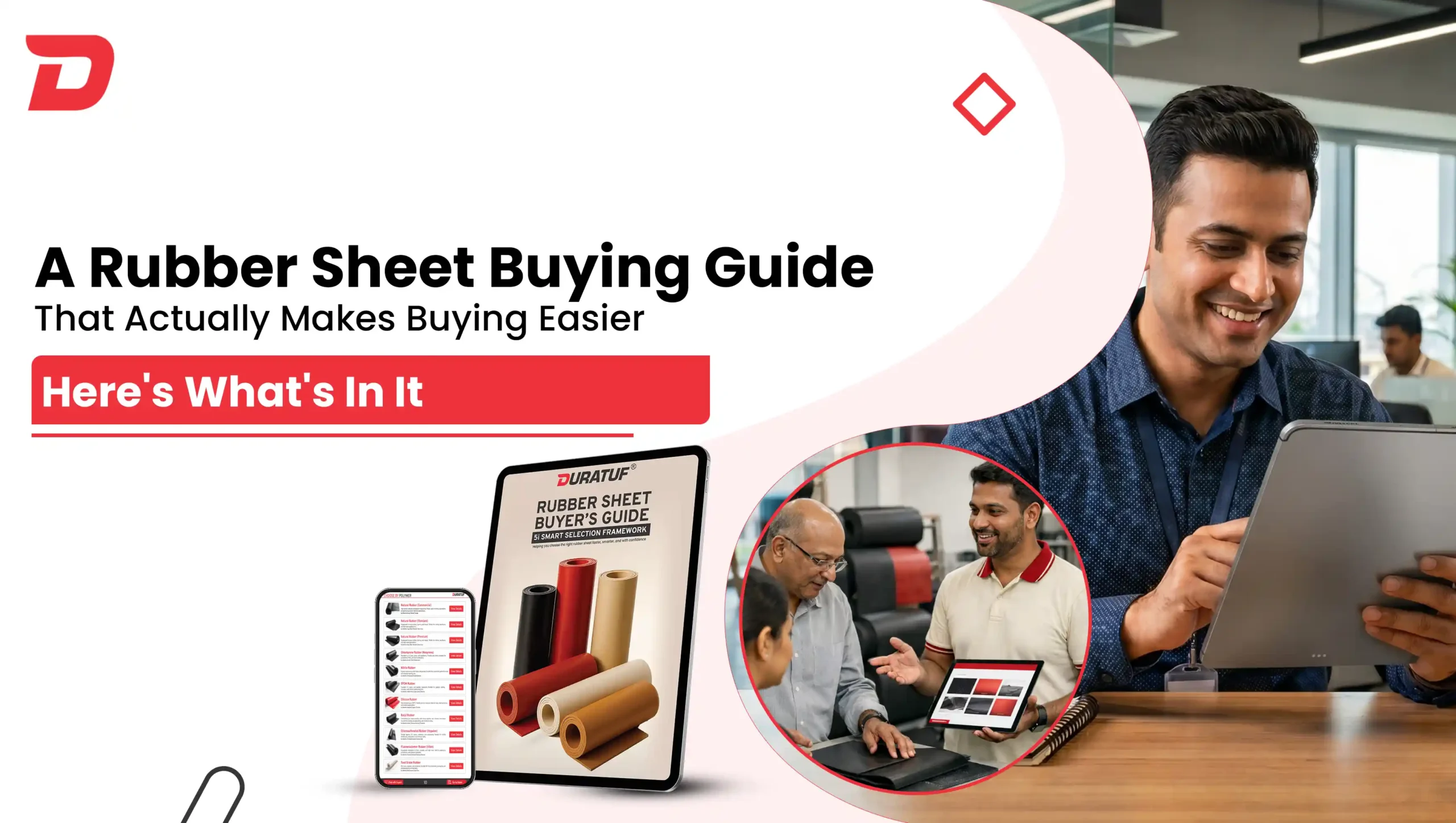
Ask any maintenance engineer who’s dealt with a failed gasket three weeks after installation. Or a procurement manager who ordered 200 meters of rubber sheet only to find out it was the wrong polymer for the application. You’ll hear the same thing: the problem didn’t start at the supplier. It started at the specification stage.
That’s a harder problem to solve than it sounds. There are over 36 rubber sheet variants in Duratuf’s range alone. Eight polymer families. Four performance grades. Temperature ranges from -40°C to +300°C. Hardness values between 38 and 80 Shore A. Customization options that most buyers don’t even know exist.
Where do you even start?
That’s the question this guide was built to answer.
What Duratuf’s Rubber Sheet Buyer’s Guide Is And Isn’t
It isn’t a catalogue. Catalogues list products. This guide helps you figure out which product is right for your situation before you pick up the phone or send an RFQ.
The guide is structured around something called the 5i Smart Selection Framework — Informative, Intuitive, Intelligent, Immersive, and Integrated. Each “i” addresses a real friction point in the buying process.
Informative means no spec gaps. Every product page has tensile strength, elongation at break, hardness, specific gravity, working temperature range, and both specified and observed test values. Tested to ASTM D412, ASTM D2240, and ASTM D297. No vague ranges. No “contact us for specs.”
Intuitive means the layout follows how buyers actually think. You don’t need to know product names to navigate it. You need to know what you’re trying to do and the guide takes it from there.
Intelligent speaks to the material selection logic built into the guide. There’s a full compatibility reference table that maps eight polymers against twelve resistance and performance criteria. You can look at your exposure conditions: petrol, acids, hydraulic fluids, abrasion, gas impermeability, working temperature, and trace across to see which polymers hold up and which ones don’t. That’s the kind of shortcut that saves real time in technical procurement.
Immersive is product photography and case studies. Not the kind you skim over, but detailed implementation examples, like the Electrosteel Castings case, where switching to Duratuf’s reinforced shot blasting sheet produced a documented 40% increase in service life, lower maintenance costs, and better dust sealing in an active production line.
Integrated means the guide closes the loop. Pricing requests, expert consultation, and datasheet downloads are accessible directly from each product entry. That matters when your decision-maker is reading the guide and wants to act on it immediately.
Three Starting Points: A head-start in the Buyer’s Guide
One of the more practical design choices in the guide is giving buyers three different starting points depending on what they already know.
Start with your application if you know the use case but haven’t settled on a material. The guide maps specific applications like industrial flooring, shot blasting protection, oil and fuel resistance, outdoor and steam exposure, heat resistance, flame retardance, chemical and corrosive media, food and pharma contact directly to product recommendations.
Start with the polymer if you already know what material you need and want to compare variants within that family. Each polymer section covers the full grade range with honest guidance on what each version does well and where it falls short.
Start with the budget if you’re working within a defined cost bracket. Products are organized into four tiers: Basic, Balanced, Long Life, and Critical Application, so you can immediately filter by what’s financially feasible without sifting through products that aren’t.
Most buying guides assume you already know how to approach the product. This one doesn’t.
The Rubber Sheet Grade System, Properly Explained
This is probably the section procurement teams will return to most.
Lite, X, Pro, and Max aren’t cosmetic labels. They reflect actual polymer content and engineering intent, and they carry different warranties.
Lite grade contains around 10% of the specified polymer. It’s designed for light-duty, cost-controlled applications with no warranty. Fine where performance demands are low. A problem when they aren’t.
X grade steps up to approximately 30% polymer content, with a 6-month warranty. The better choice for general industrial use where Lite isn’t durable enough.
Pro grade sits at 50% polymer content and a 12-month warranty. Most buyers working in active industrial environments land here. It is the balance point between performance and cost.
Max grade is 100% polymer, 24-month warranty, and built for demanding environments where a failure means real operational consequences. Shot blasting chambers. Chute linings in mining. Heavy-duty marine fender applications. Chemical tank linings.
Two products can both say “EPDM rubber sheet” on the invoice and perform completely differently. The grade system is why. The guide makes this visible in a way that most supplier datasheets don’t.
What Else the Guide Covers
Beyond product selection, the guide goes into customization ranges i.e. thickness up to 60mm, width up to 2500mm, any color subject to polymer feasibility, four surface finish options, and the option to apply customer brand names or batch identification markings directly to the sheet.
There’s a full packing and delivery section that covers standardized roll configuration, HDPE moisture-resistant wrapping for sea transit, fumigated wooden pallets for export, and LCL and FCL container availability for both domestic and international shipments.
And there’s a sample request section with specific turnaround times. Standard grades in 2 to 4 working days, custom thickness in 3mm to 7mm, multi-grade kits in 3mm to 5mm. It helps buyers evaluate before committing to bulk buy.
10 Reasons Buyers Are Using This Guide Instead of Going Back and Forth With Suppliers
Here are 10 ways in which this guide stands out:
- Cuts specification time. Polymer data, grade comparisons, application mapping, one document instead of five browser tabs and two supplier calls.
- Backs your internal recommendation. Observed test values and application rationale turn “I think this is right” into something you can actually present upward.
- Explains the grade system plainly. Lite, X, Pro, Max reflects polymer content, warranty, and engineering intent, not just price tiers. Knowing this prevents a lot of wrong orders.
- Works for non-technical buyers too. You don’t need a materials background. If you know what the sheet needs to do, the guide gets you to the right product.
- Stop over-specifying. A Max-grade sheet in a light-duty application wastes budget without any performance gain. The “Best for / Not recommended for” structure on each page keeps the spec honest.
- Covers logistics, not just product. Sea-transit wrapping, pallet specs, LCL and FCL availability. Buyers who’ve had goods arrive damaged know this part matters.
- Sample process is already mapped out. Turnaround times, formats, and what information to send, it’s in there. No chasing.
- Export and compliance-ready. REACH, RoHS, CE, FDA certification details are included. Shortens due diligence for international procurement considerably.
- Real test numbers, not just specified ranges. Observed values sit alongside minimum specs on every datasheet. That’s manufacturing consistency made visible.
- Goes straight from information to action. Pricing requests, datasheet downloads, expert consultation — accessible directly from each product entry. No dead ends.
Duratuf operates across 65+ countries with certifications including ISO 9001, ISO 14001, ISO 45001, REACH, RoHS, CE, and FDA. The Rubber Sheet Buyer’s Guide is available now.