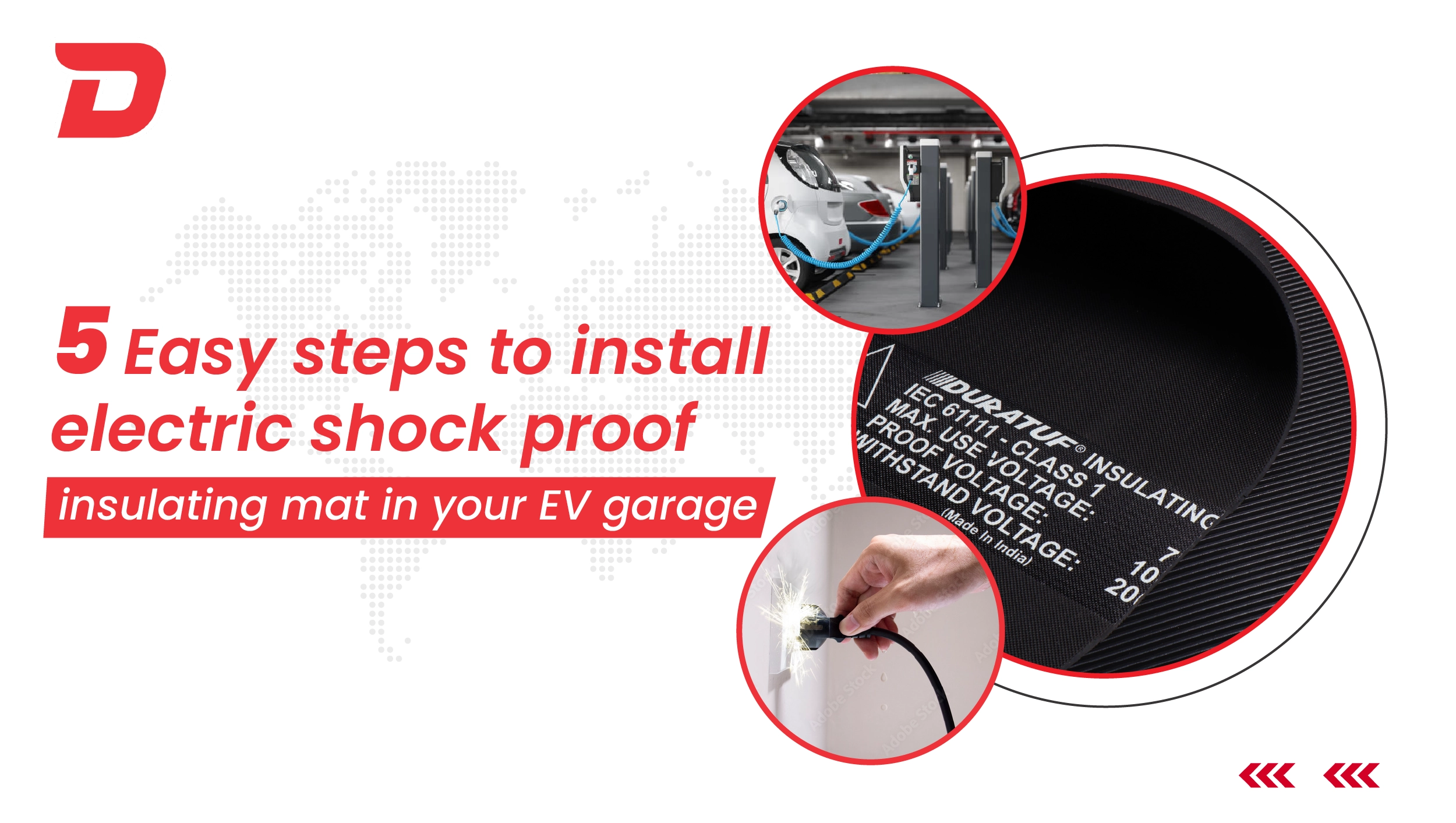
EVs or Electric Vehicles are the future, with the global electric vehicle fleet projected to reach around 116 million units in 2026, reflecting rapid uptake across key markets including India, China, Europe and emerging economies. According to the International Energy Agency’s latest outlook, under current policies the stock of EVs across all vehicle types is expected to grow roughly fourfold by 2030 compared with 2024 levels, reaching around 250 million EVs on the road.
EV sales continue to surge and EVs are projected to account for about 40 % of new car sales by 2030. This rise is parallel in commercial and residential setups. Along with this hype around EVs comes another deadly risk: electric shocks. That is why we will help you prepare your EV garage with an electric shock-proof insulating mat.
In this blog, we will break down why electrical insulating shock-proof mats matter. You will also get to know what their standards mean and how to choose the right one for your EV garage, paying the correct electric shock-proof insulating mat price
Why Electrical Shock Proof Mats are Crucial for EV Garages?
Electric vehicles are not like conventional cars. They operate between 400 Volts and 800 Volts, with some reaching up to 1000 Volts. Such high voltages can cause deadly electric shocks if not handled properly and without protective equipment like an electric shock proof mat.
Some common risk scenarios are:
- Charging system faults
- Battery disassembly or diagnostics
- Wet or conductive flooring
- Improper grounding during maintenance
- Use of metallic tools near live connections
According to the National Fire Protection Association (NFPA), many EV-related electrical incidents are caused by inadequately equipped home garages or a lack of personal protective equipment (PPE) in workshops.
How to Prepare Your EV Garage for Electrical Shock Proof Mat Installation?
Have you bought the electric shock proof rubber mat yet? Or, are you still doing your research? Well, if you haven’t bought electric rubber matting rolls yet, we recommend that you always settle for a certified product.
Uncertified electrical shock resistant safety mats are cheaper, but they are not safe. No certificate means they haven’t been tested for safety. On the other hand, if you have bought an electric shock proof insulating mat, ask your supplier for the test certificates. Industry standards and certifications guarantee the safe use of electric mats.
Now, if you have bought electric rubber mats and they are certified too, the next step will be the first for you:
1. Division of Zones and Identification of High-Risk Areas
There are low, medium, and high voltage zones in your EV garage. You can start by identifying the areas exposed to the highest voltages, like:
- Under wall-mounted or floor chargers
- Around control panels or power distribution boards
- Beneath EV lifts or mobile tool carts
- EV battery workstations
Why is it important to divide the areas electric-intensity wise? An electric shock proof mat comes in various classes. For example, an IEC 61111:2009 electrical rubber mat is divided into 5 classes for 1 kV, 7.5 kV, 17 kV, 26.5 kV, and 36 kV. The features and electrical shock proof insulating mat price differ with each class.
2. Choose the Right Electrical Mat Type and Class
Electrical shock resistant safety mats are compliant with either IEC 61111:2009, IS 15652, or ASTM D178 electrical safety matting standards.
You should match your electrical mat with the working voltage of the equipment in the EV garage. An example of that is below:
| Use Case | IEC 611111 Recommended Class |
| Home garage EV charger (≤1kV) | Class 0 |
| EV maintenance bay (≤7.5kV) | Class 1–2 |
| Commercial EV fleet hub (≥15kV) | Class 3–4 |
Additionally, look out for these features in whatever electric shock proof insulating mat class you choose:
- Anti-slip surface (fine-ribbed, large-ribbed, dotted, textured, etc.)
- Oil, Ozone, UV, and chemical resistance
- Water repellency
- Proven dielectric strength
3. Surface Preparation Before Installation
Once you have identified high-risk areas and bought the right electric shock proof rubber mat, you can move on to the most critical part of the job, which is installation.
Prepare the surface by cleaning the area- especially making it free of grease, oil, and moisture. You can simply sweep and mop the floor. Allow the area to dry completely before laying the electric mats.
Note: Water is a good conductor of electricity. Therefore, even the slightest trace of water on the floors will interfere with the efficiency of the electrical insulating shock proof mats.
4. Lay the Mats on the Floor
After preparing the surface, simply lay the mats on the floor. There should be no trapped air bubbles inside. The mat should stay in place without having any folded corners. If needed, you can cut the corners of the electrical shock resistant safety mats. Nonetheless, we do not recommend that users cut the mat on their own. If you require narrower or shorter mats, talk to your electric shock proof mats manufacturer.
Many users prefer gluing the mats to the floor. However, you won’t be able to clean the mats or the floor below if you apply glue. The IEC 61111:2009 and ASTM D178 switchboard mats have a thicker surface. Hence, they do not move much in moderate traffic areas if you do not apply adhesive.
5. Inspect from Time to Time
Electrical shock proof mats have a shelf-life of 5+ years if maintained with care. Store the mats in their roll form or lay flat if you do not need them at the moment, or bought them in bulk.
Inspect the electrical mats for cracks, wear, or discoloration.
Replace the electric mat every 3-5 years or as your electrical mat supplier recommends.
Applications of Electrical Shock Proof Mat in EV Garage
An EV garage is not one uniform electrical environment. Exposure ranges from a 230V AC wall box in a home garage to an 11kV HT panel feeding a fleet charging hub. So the electrical shock proof mat class you lay in each zone should follow the equipment in that zone, not the overall size of the workshop.
Here is where insulating mats actually go inside an EV garage, and what class each position calls for:
| Application Zone | What the Technician is Exposed To | Recommended IEC 61111 Class |
| AC wall box and home charging point | LV supply up to 1kV, connector and cable faults | Class 0 (1kV) |
| DC fast charging bay and dispenser cabinet | 400V to 1000V DC output, rectifier section | Class 0 to Class 1 |
| HV battery pack service bay | 400V to 800V DC pack, live terminals during diagnostics | Class 0 to Class 1 |
| Battery module disassembly and repair bench | Exposed cells and busbars with no isolation guarantee | Class 1 (7.5kV) |
| Inverter, motor and powertrain test area | High voltage under load conditions | Class 1 (7.5kV) |
| LT distribution board and metering panel | 415V three phase, arc flash risk | Class 0 to Class 1 |
| HT panel, RMU or transformer room feeding the hub | 11kV to 33kV distribution side | Class 2 to Class 4 |
| EV lift, inspection pit and tool cart area | Wet floors, trailing leads, dropped metallic tools | Class 0 minimum |
| Spare battery storage and charging room | Multiple packs charging simultaneously | Class 1 (7.5kV) |
| Training, demo and delivery bay | Untrained visitors near live equipment | Class 0 (1kV) |
Do you Need Expert Help in Installing Electrical Shock Proof Mat?
Can you install the electrical mats yourself, or do you need expert help? The electric shock proof insulating mat price is not low. Thus, even wasting one electrical matting roll to experiment is a loss.
Quick Checklist for EV Garage Insulating Mats
- Complies with IEC 61111/ ASTM D78/ IS 15652
- Correct class for voltage exposure
- Anti-slip and flame-retardant
- Regular inspection and maintenance
- Positioned on all work zones
The truth is- No. You do not need specialist help when installing the electrical mats. But expert guidance during the purchase can save you time and money. Experts can direct you accordingly, demonstrating the pros, cons, and applications of each matting type.