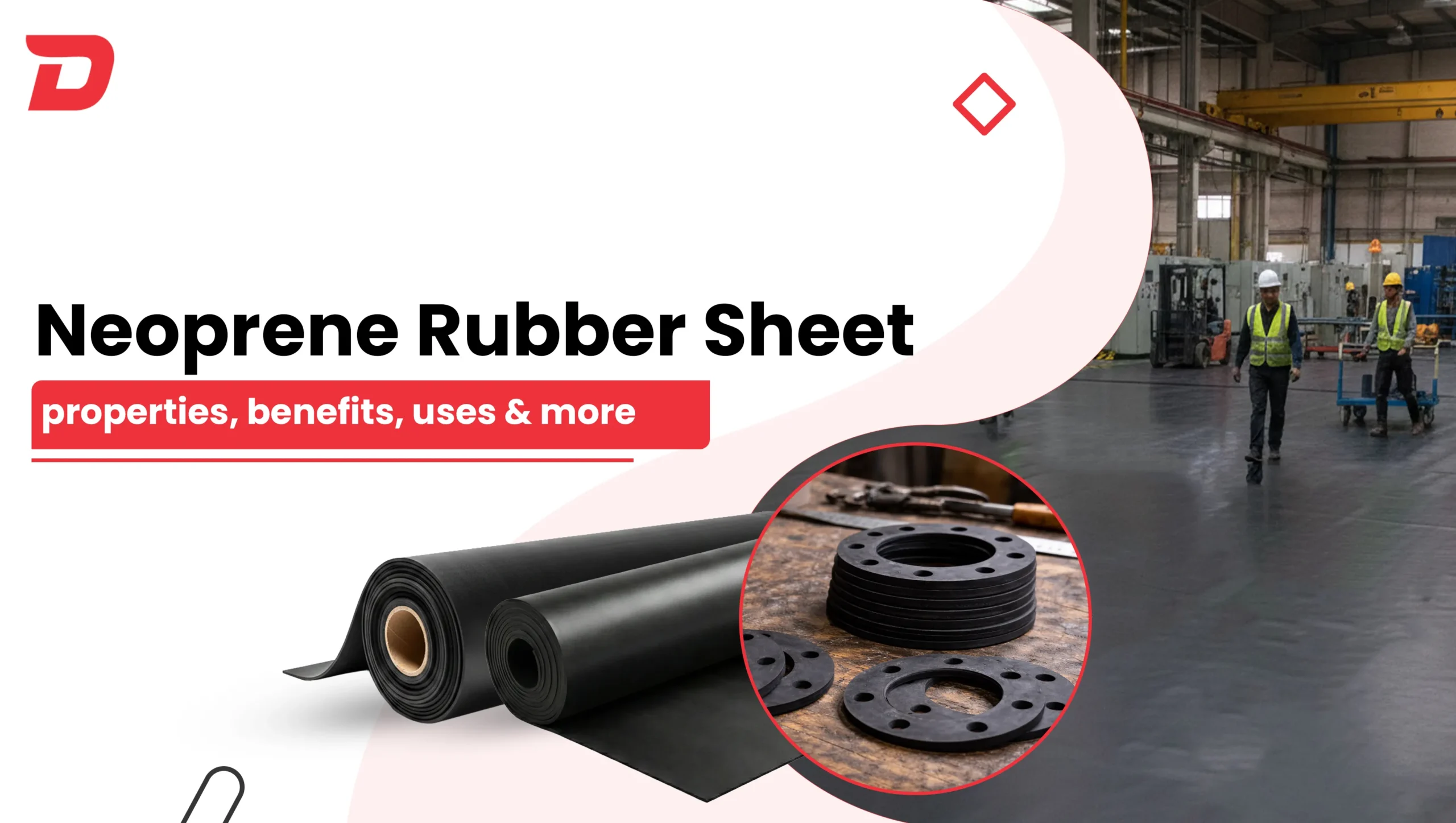
A neoprene rubber sheet is not only extremely versatile (the main reason for which they are known to have high mechanical strength), but it also exhibits some of the best resistance to petroleum, oils, and also changes in external weather conditions. These are but some of the properties for which they are manufactured by producers of rubber and PVC products, particularly for fire resistance, isolation, and sealing purposes.
However, the fascinating aspect for which these sheets are so highly sought after is that these sheets unlike other cheap rubber sheets are worth every penny and are also stable and immune to the adverse effects of UV rays and ozone, and also to extreme weather conditions.
What are the Features of Neoprene Rubber Sheet?
Rubber sheet that is highly durable
A neoprene rubber sheet, in most cases, has a maximum Durometer rating of 60, which makes these rubber sheets one of the most highly flexible and durable rubbers available on the market.
Quality of resistance
Moreover, these rubber sheets are known for their ability to show moderate resistance against petroleum products, and environmental factors.
These are the properties for which these neoprene rubber sheets have been able to garner significant fame over a short period of time.
Vibration dampening:
Neoprene rubber sheeting is used as an anti-vibration mount due to its vibration-dampening properties. It can make the vibration frequency negligible. As a result, this rubber sheeting reduces noise and mechanical wear of machine parts.
Some bonus information to end the blog:
- Can easily withstand outdoor conditions.
- They have little chance of catching fire.
- Can be used for the purpose of industrial seals, gaskets, and many other applications.
- They have some of the best adhesion to a metal surface.
- They can be used in areas where there is a moderate presence of chemicals and oils.
Given below is a list of some of the uses and applications of this type of sheet!!
What are the Properties of Neoprene Rubber Sheet?
Oil and Weather Resistance Balance
Neoprene’s core property is balance rather than dominance in any one category. It rates fair for lubricating oil resistance and poor for direct petrol exposure, similar to other general-purpose elastomers, but it holds up well against weather, ozone, and UV exposure where nitrile and natural rubber both fall short. This balance, not a standout rating in either direction, is what makes it a moderate-everything material rather than a specialist.
Chemical Resistance
Neoprene handles most everyday chemical exposure reasonably well, but its resistance drops against concentrated or aggressive chemicals. For heavy, sustained chemical exposure, EPDM or Hypalon (CSM) are the better fit, neoprene is suited to moderate, intermittent exposure rather than continuous immersion.
Flame and Temperature Resistance
Neoprene is inherently flame retardant, one of the few common rubber sheet types with this property built in rather than added through compounding. Across Duratuf’s Neo65 range, operating temperature spans -20°C to +110°C depending on grade. Neo65 Lite and Neo60 X are rated to +70°C, Neo65 Pro extends to +90°C, and Neo65 Max, the fully compounded 100% CR grade, is rated for continuous use up to +110°C.
Resilience and Durability
Hardness across the range runs 60° to 65° Shore A, with tensile strength climbing from 4.2 MPa on Neo65 Lite up to 10.6 MPa (observed) on Neo65 Max, and elongation at break up to 368%. That mechanical strength, combined with a good compression set rating, is also what makes neoprene sheeting effective as a vibration-dampening material. It absorbs and holds its shape under repeated mechanical load rather than fatiguing early, which is why it shows up in anti-vibration mounts as much as in sealing applications.
What are the Uses of Neoprene Rubber Sheets?
In the automotive sector
In today’s world, especially in the automotive sector, a neoprene rubber sheet has plenty of areas of applications. For example, these sheets are used for many under-the-hood as well as plenty of under-body parts applications, which need reasonably priced and high-performance polymers that have a standard all-around balance of properties based on performance.
Moreover, these sheets can be used for a number of other purposes in various other industries like mass transit, food preparation, construction, wire and cable, and the list just goes on.
In the mass transit sector
The only usage of certified and tested neoprene compounds is applied in the mass transit sector, which includes vehicles like buses, cars, trains, and many more so that you can be completely assured of the fact that the material you are going to put in use is going to fulfill all your expectations.
Using these rubber components, in this case, a neoprene rubber compound has specific advantages that play an important part and also provide certain advantages that are essential for door and window seal extrusions.
It is for this reason that neoprene, a rubber compound that provides excellent resistance to smoke, toxicity, and flame and also meets the entire requisite set of specifications is given so much importance in this particular sector.
In the food preparation sector
Experts who deal with rubber compounds recommends using neoprene rubber compounds in order to match the specific operating conditions and the various industrial regulation that is applicable only to the food preparation industry.
Furthermore, these compounds are approved by the FDA and other administrative bodies around the world for their non-contaminating properties, and also because it supports the primary functions of the application.
Custom rubber components are also used which are specially meant to suit your food preparation applications and can also last long enough in a specific environment..
Other Uses of Chloroprene (Neoprene) Rubber sheet:
- Isolation barriers.
- Transfer and join sleeves.
- Chassis rubbers.
- Expansion joints, etc.
Why Chloroprene Rubber Sheet is Popularly Known as Neoprene Rubber Sheet?
Neoprene rubber sheets are a registered trademark product of chloroprene rubber that is produced by none other than the DuPont Company.
But, because neoprene rubber sheets have been able to garner significant popularity, that nowadays all chloroprene rubber sheets are now referred to as neoprene rubber sheets.
Therefore, it would not be an exaggeration at all if someone says that all neoprene rubber sheets are chloroprene rubber sheets, but all chloroprene rubber sheets are not neoprene rubber sheets.
Why Choose Duratuf for Neoprene Rubber Sheets?
Duratuf’s Neo65 range covers four grades, Neo65 Lite, Neo60 X, Neo65 Pro, and Neo65 Max, so the CR content and price point can be matched to how demanding the application actually is, rather than defaulting to the heaviest grade for every order.
| Grade | CR Content | Temperature Range | Tensile Strength (Observed) | Warranty |
| Neo65 Lite | 10% | -20°C to +70°C | 4.2 MPa | Nil |
| Neo60 X | 30% | -20°C to +70°C | 4.3 MPa | 6 months |
| Neo65 Pro | 50% | -30°C to +90°C | 5.5 MPa | 12 months |
| Neo65 Max | 100% | -30°C to +110°C | 10.6 MPa | 24 months |
As an industrial safety solutions company operating for 16+ years, Duratuf has supplied rubber sheeting to more than 4,142 customers across 65+ countries, dispatched from our Bhiwadi (India) and Dubai (UAE) warehouses. All grades are backed by ISO 9001, ISO 45001, and ISO 14001 certification, with custom thickness, width, and finish available on request.
If you need help choosing the right Neo65 grade for your application, request a free sample or speak to our product team for a technical datasheet.