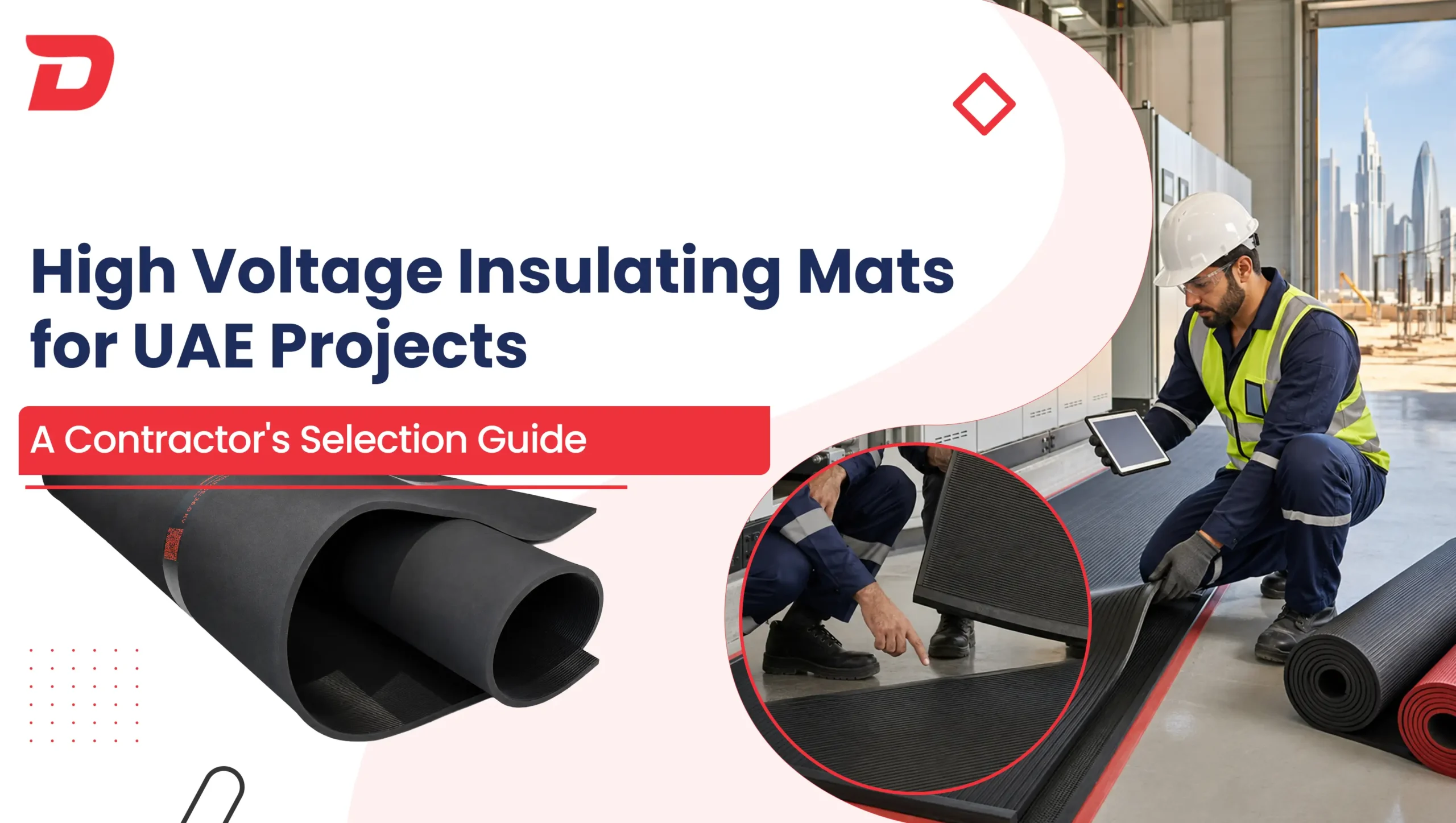
Electrical safety is a critical consideration on UAE construction, infrastructure, and industrial projects, especially in areas where personnel work around energized electrical equipment. From low-voltage switchboards and control panels to high-voltage substations and transformers, each electrical environment requires the right level of insulation and protection.
One of the most important factors when specifying an electrical insulating mat is its voltage class. A 415V switchboard room does not have the same requirements as a 33kV distribution substation, and using a mat that is not suitable for the operating voltage can compromise both worker safety and project compliance.
For contractors, electrical consultants, and procurement teams in the UAE, selecting the right mat means looking beyond thickness or material alone. The mat should be matched to the required IEC 61111 class, working voltage, installation environment, and project specifications.
In this guide, we explain how to select high-voltage insulating mats for UAE projects, which IEC 61111 voltage classes are suitable for common electrical applications, and the five specification mistakes contractors should avoid to maintain electrical safety and compliance on site.
What Qualifies as a High Voltage Insulating Mat?
An electrical insulating mat is a dielectric rubber product designed to isolate a worker from a live electrical surface. The word “high voltage” refers to the mat’s certified voltage class, not just its physical thickness.
Under IEC 61111:2009, electrical insulating mats are classified into five classes (0 to 4), each rated for a specific maximum use voltage. A mat must be tested and certified to its claimed class by a recognised laboratory before it can carry that rating. General-purpose rubber flooring, anti-fatigue mats, and uncertified rubber sheeting do not qualify, regardless of thickness or marketing language.
In the UAE, IEC 61111 is the accepted standard across utility and government-governed facilities, including sites under DEWA, ADWEA, ADDC, and SEWA oversight.
IEC 61111 Voltage Class Reference
All IEC 61111 electrical rubber mats are manufactured to IEC 61111:2009 standards. The table below gives the five voltage classes, their certified ratings, and the recommended thickness for each.
| Class | Max Use Voltage | AC Proof Voltage | Withstand Voltage | Recommended Thickness |
| Class 0 | 1.0 kV | 5.0 kV | 10.0 kV | 2.0 mm |
| Class 1 | 7.5 kV | 10.0 kV | 20.0 kV | 2.0 mm |
| Class 2 | 17.0 kV | 20.0 kV | 30.0 kV | 3.0 mm |
| Class 3 | 26.5 kV | 30.0 kV | 40.0 kV | 4.0 mm |
| Class 4 | 36.0 kV | 40.0 kV | 50.0 kV | 5.0 mm |
Which Class Does Your UAE Site Need?
Most UAE construction and industrial sites involve one or more of the following electrical environments. Use this as a starting reference; always confirm the site system voltage against the project’s electrical drawings before specifying.
| UAE Site Application | Typical System Voltage | Required Class | Product Code |
| LV switchboards, control panels, distribution boards | Up to 415 V | Class 0 | IM-IEC-C0 |
| 3.3 kV MV panels and ring main units | 3.3 kV | Class 1 | IM-IEC-C1 |
| 11 kV switchgear rooms and MV substations | 11 kV | Class 2 | IM-IEC-C2 |
| 22 kV / 25 kV distribution systems | 22–25 kV | Class 3 | IM-IEC-C3 |
| 33 kV substations and HV installations | 33 kV | Class 4 | IM-IEC-C4 |
Note: This mapping reflects standard UAE distribution voltage levels. Confirm with project electrical specifications before ordering.
5 Mistakes UAE Contractors Make When Specifying High Voltage Insulating Mats
These are the most common errors that EHS managers and procurement teams on UAE sites make. Each one either creates a compliance failure, a safety risk or an avoidable project delay.
Mistake 1: Specifying by Thickness Instead of Voltage Class
Thickness and dielectric rating are not the same thing. A 6 mm general rubber mat is not equivalent to a 6 mm IEC 61111 Class 2 mat, even if they look identical. The dielectric protection comes from the compound formulation and the type test it has passed, not from how thick the material is.
The correct procurement sequence is: identify the system voltage at the work location, then select the corresponding IEC 61111 class. Thickness follows the class, not the other way around.
Mistake 2: Using the Same Mat Class Across Different Voltage Zones
UAE projects often have mixed electrical environments within the same facility: a 415 V distribution room on the ground floor and an 11 kV switchgear room on the same level or floor above. A Class 0 mat rated for 1.0 kV is not interchangeable with a Class 2 mat rated for 17.0 kV.
Each voltage zone needs its own rated mat. Substituting a lower class in a higher-voltage environment because “a mat was available” is a serious safety failure and typically a compliance breach on any DEWA or ADWEA-governed site.
Mistake 3: Not Requesting the Dielectric Type Test Certificate Before Purchase
IEC 61111 compliance must be backed by a dielectric type test certificate from an accredited laboratory. This is not documentation you request after delivery; it should be confirmed before the purchase order is issued.
Many mats are marketed as “electrical grade” or “high voltage grade” without a verifiable type test report. Ask your supplier to share the IEC 61111 type test certificate and confirm the class and standard on the document. If a supplier cannot produce this, the mat has no verifiable compliance claim, regardless of what the label says.
For IEC 61111 mats, certificates are available on request through Duratuf’s resources section.
Mistake 4: Sourcing Without Confirming In-Country Stock Availability
Custom insulating mat orders can take four to six weeks if the supplier is manufacturing to order. On a construction project or maintenance shutdown with a fixed schedule, a mat supply delay can hold up commissioning of an entire electrical room.
Suppliers with in-country stock in the UAE remove this risk. Duratuf stocks IEC 61111 insulating mats across Classes 0 to 4 from its Dubai warehouse at Dubai Investments Park. Standard roll dimensions (10 m length, 1 m width) are available for immediate dispatch within the UAE and GCC.
Mistake 5: Inadequate Site Storage Degrading Dielectric Properties Before First Use
Insulating mats are elastomeric products. The same properties that give them dielectric strength also make them susceptible to environmental degradation if stored incorrectly. UAE site conditions, with ambient temperatures regularly exceeding 45°C and intense UV exposure, accelerate degradation faster than in temperate climates.
Store insulating mats flat (never folded or rolled tightly around a sharp core), indoors and away from direct sunlight, in a dry area with no exposure to oil, solvents, or ozone-generating equipment such as arc welders. IEC 61111 mats are tested for performance after ageing at 70°C for 168 hours; their mechanical puncture resistance retains at least 80% of its original value under those conditions, but only if storage conditions are otherwise maintained.
Duratuf IEC 61111 Insulating Mats: Available for UAE Projects
Duratuf IEC 61111:2009 insulating mat range designed for international markets including the UAE and wider GCC. All five voltage classes are available, with the following standard specifications:
- Classes available: Class 0 (1.0 kV) through Class 4 (36.0 kV)
- Standard roll size: 10 m length x 1.0 m width
- Anti-skid finish: Top Fine Ribbed, Bottom Textured (Class 2 and above); Top and Bottom Textured (Class 0 and 1)
- Working temperature: -25°C to +55°C
- Colour: Black (standard); Dark Grey available
- Customisation: Width up to 1,220 mm, length up to 15 m, custom colours subject to feasibility
- UAE dispatch: Stocked at Duratuf’s Dubai warehouse, Dubai Investments Park
Duratuf has supplied insulating mats to 4,142+ customers across 65+ countries over 16+ years. Our electrical mats are accepted on facilities governed by DEWA, ADWEA, ADDC, and SEWA where IEC 61111 compliance is specified.