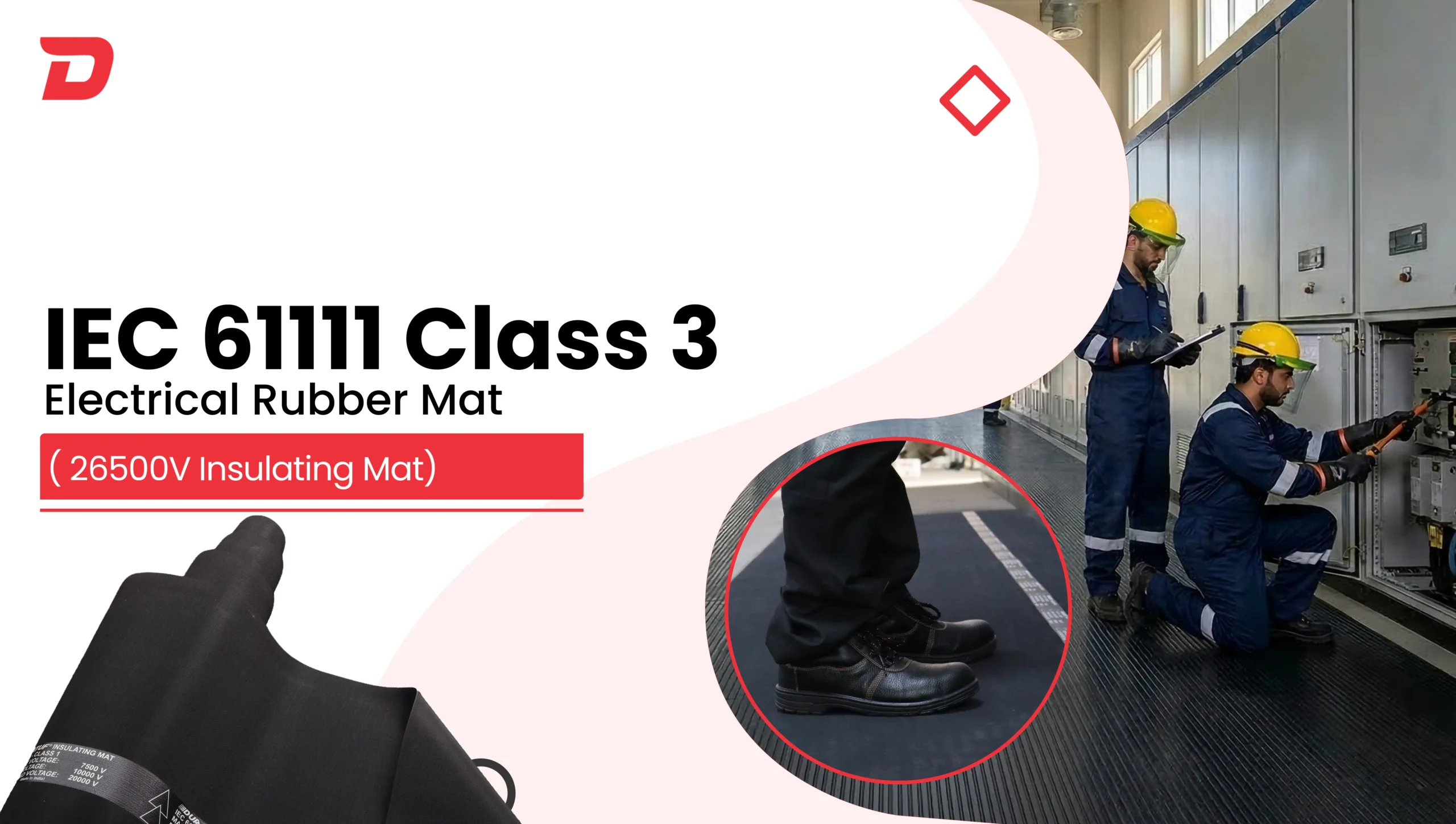
When working in high-voltage environments where the operating voltage reaches up to 26,500V AC, the IEC 61111 Class 3 electrical rubber mat is the appropriate insulating floor mat. It provides robust dielectric protection for workers in power plants, electrical substations, and industrial high-voltage switchgear rooms.
This article provides a complete breakdown of the Class 3 insulating mat including its technical specifications, applications, material properties, installation guidance, and common questions.
What is an IEC 61111 Class 3 Electrical Rubber Mat?
An IEC 61111 Class 3 electrical rubber mat is a high-performance elastomer floor mat designed to insulate workers from electrical hazards where voltages go up to 26,500 volts AC. It is proof tested at 30,000V and must withstand 40,000V during the required dielectric test.
Class 3 mats are 4 mm thick and are heavier and more robust than lower-class mats, reflecting the more demanding environment in which they are used.
Key Voltage Ratings for Class 3:
| Specification | Value |
| Max Use Voltage (AC) | 26,500 V |
| AC Proof Voltage | 30,000 V |
| Withstand Voltage | 40,000 V |
| Recommended Thickness | 4.0 mm |
| Max Thickness Allowed | 11 mm |
| Standard Length | 10 m |
| Standard Width | 1.0 m |
Where is IEC 61111 Class 3 Mat Used?
Class 3 mats are used in industrial and utility power sector environments with voltages in the 11kV to 26.5kV range. Applications include:
- Electrical substations handling 22kV and 33kV systems
- Power plants including high-voltage generator and turbine control areas
- Industrial switchboard rooms for high-voltage distribution at 22kV
- Transformer stations with high-voltage switching areas
- High-voltage testing labs and electrical research facilities
- Railway traction power substations
- Cable trench areas and busbar sections in high-voltage installations.
If your facility operates at 22kV or 33kV, you should evaluate whether a Class 3 mat or Class 4 mat is appropriate based on the exact working voltage.
Material and Design Features
Class 3 mats are engineered for demanding high-voltage environments. They share the same material base as other IEC 61111 classes but are thicker and denser:
- Premium elastomer: Natural rubber and synthetic polymers, no insertions
- 4.0 mm thickness for enhanced insulation performance
- Fine ribbed anti-slip top surface for maximum traction
- Textured anti-skid underside for firm floor contact
- Flame retardant, will not catch fire under standard test conditions
- Resistant to mild acids, alkalis, water, oil, and moisture
- Ozone and UV resistant for long service life
- Standard marking every meter: Which shows class, voltage rating and product name.
- Operating temperature: -25°C to +55°C
Technical Specifications of IEC Class 3 Electrical Mats
| Technical Property | Performance Value |
| Material | Elastomer – Natural Rubber + Synthetic Polymers |
| Mechanical Puncture Resistance (min) | 70 N |
| Slip Resistance (min) | 50 N |
| Flame Retardance | Does not catch fire |
| Low Temperature Test (-25°C) | No visible tears or cracks |
| Acid Resistance | Mechanical values ≥ 75% of original |
| Oil Resistance | Mechanical values ≥ 75% of original |
| Aging at 70°C for 168 hrs | Puncture resistance ≥ 80% of original |
| Weight per Roll (10m x 1m) | Approximately 56 kg |
How to Choose Between Class 2 and Class 3
If you are deciding between a Class 2 mat and Class 3 mat, the answer depends entirely on the highest voltage present in your installation. Use the guide below:
| Working Voltage in Your Facility | Recommended Mat Class |
| Up to 1,000 V | Class 0 |
| Up to 7,500 V | Class 1 |
| Up to 17,000 V (11kV systems) | Class 2 |
| Up to 26,500 V (22kV systems) | Class 3 |
| Up to 36,000 V (33kV systems) | Class 4 |
Never downgrade to a lower class to save cost. Always match or exceed the voltage rating of your installation.
Installation and Safety Precautions for Class 3 Insulating Mat
Proper installation is very important for IEC class 3 insulation mats to ensure its long-term performances and safety complaints. Here is a safety precautions to follow while installing this mats:
- Ensure the floor is completely clean and dry before placing the mat.
- Position the mat to cover the full standing area in front of the equipment.
- Do not fold or crease the mat at any time.
- Do not overlap adjacent mat sections, lay them edge to edge.
- Always inspect visually before use. Remove if any damage is observed.
- Combine with insulating gloves, safety boots and arc flash PPE where required.
- Follow the manufacturer’s maintenance and re-testing guidelines.
Conclusion
The IEC 61111 Class 3 electrical rubber mat is a critical safety product for high-voltage power environments operating at up to 26.5kV. Ensure it is sourced from a certified manufacturer and supplied with full test documentation.